
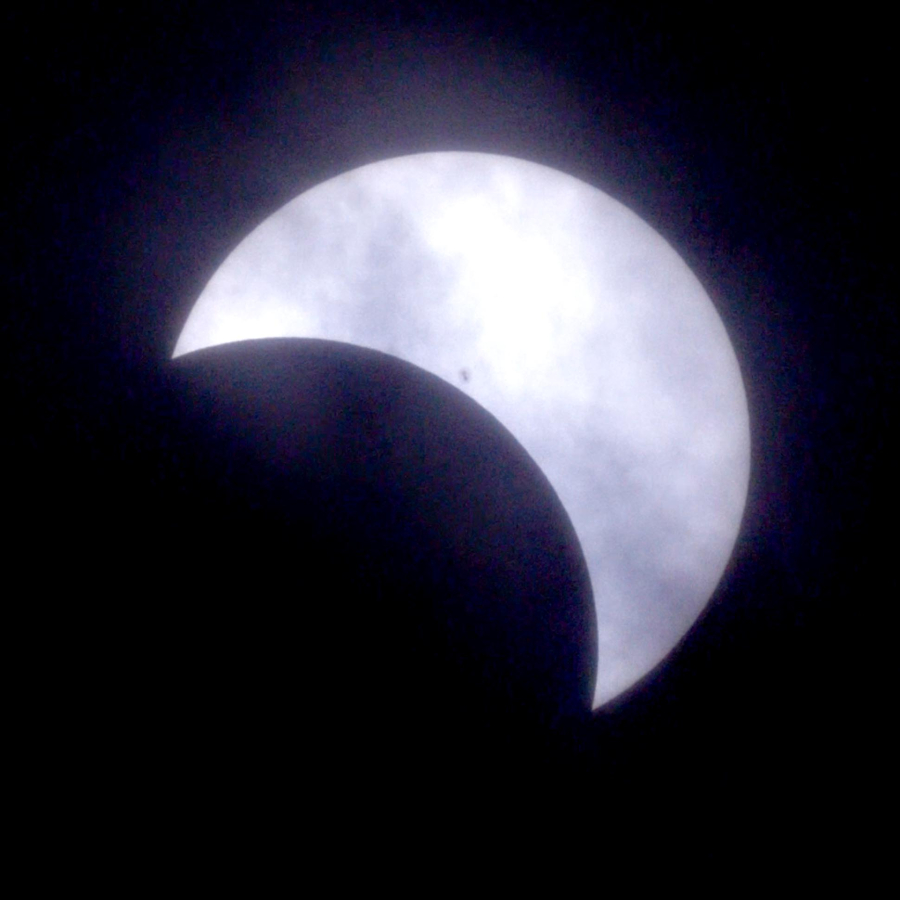
The last time a total solar eclipse occurred in Manitoba was 45 years ago, February 26 1979, when the path of totality passed over Southwestern Manitoba. The next total solar eclipse visible in Manitoba will happen 230 years from now on May 17, 2254, following a path very similar to the eclipse in 1979.
A solar eclipse occurs when the moon passes directly in front of the sun during the new moon. Naturally this leads to the question why does it not occur once a month during every new moon? The reason is because the moon’s orbit is slightly tilted. At one side of its orbit during the new moon it will appear 5.1 degrees above the sun in the sky; on the other side of the orbit it would appear 5.1 degrees below the sun. This means there are only two portions of the moon’s 27.3 day orbit where it is neither above or below the sun and when this coincides with the new moon an eclipse occurs.
To make matters more complicated the moon does not orbit us in a perfect circle. It orbits in an elliptical shape with one side of the orbit closer to us than the other. If the eclipse happens when the moon is too far away to completely cover the sun it is called an annular eclipse. These are often referred to as a “ring of fire” because a ring of the sun remains visible around the moon during the maximum. Although eclipses occur at least twice a year they are only visible over a small portion of the planet. At any given location a total solar eclipse will occur on average every 375 years.
by REGAN COGHILL