

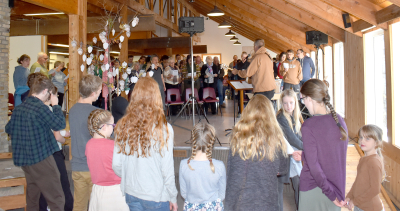
With 60 years behind it, Camp Koinonia is looking to continue its mission into the future.
The camp on the shores of Lake Max celebrated its 60th anniversary on October 24-25. According to board member Simon Dueck, it was a fun time.
“We had our annual Woodcutter Retreat, where we get the wood for the year,” he explained, “so we had a few extra people to help with that. Then we had the worship service on Sunday, and people shared stories of Camp Koinonia, from being there as children, as staff. It was a good crowd, we had a lot of people who were connected come out. I think we had 150 people here.”
The story of Camp Koinonia actually goes back 20 years before its establishment. In 1948, a need for summer camps for youth was noticed and the Conference of Mennonites in Manitoba established its first camp along the Assiniboine River. Another was later added at Moose Lake. By 1964, the Conference voted to establish one on Lake Max. Opening in July 1966 it was originally called Camp Lake Max before changing to Camp Koinonia in 1970.
The summer camp is run by Camps With Meaning, owned by Mennonite Churches Manitoba. In 2016, a local board was created to run the camp, taking care of the maintenance and encouraging more use of the facilities during other times of the year.
“They wanted to keep it going, and took over the facilities themselves. We’re still there, and are always trying to find a way to make it sustainable into the future.”
Dueck is a newcomer to the board. He had attended the Assiniboine Camp as a child, but also visited Koinonia. He spent time as staff with Camps With Meaning, which also brought him out to the area.
As he explained, the main spot on the camp is the lodge, which can sleep up to 60 people, as well as the mini lodge and cabins. There is plenty to do in the area in all seasons, from hiking, canoeing and kayaking in the warmer months, to skiing in the winter, as they are close to the Lake Max trails. It showcases the Turtle Mountain Provincial Park well.
Voters had the opportunity to see what their municipal candidates are all about, and took advantage of it.
Boissevain Legion was full on October 14 of those seeking a peek into those running for Boissevain-Morton Council in next week’s election. With a full slate of candidates for both council and the head position on hand, they were able to see what their thoughts were on key issues.
Emceed by Barry Lamb, the event initially gave candidates an opportunity to introduce themselves to the voters. Council hopefuls David Stead, Mike McCallum, Eric Reichert, and Rhonda Coupland are trying to return, with Rob Adams attempting to move to the mayoral chair. Lonnie Graham and Doug Troke are attempting a comeback, RM of Cornwallis councillor Ed Maxwell is trying to take a position in his old/new area, and Laurie Nestibo, Craig Barwick and Duane Latimer are new candidates. Terry Lucier is running against Adams for the head of council slot.
After introductions, four questions were asked of the candidates, highlighting different issues in the community. The event was organized by the Boissevain Community Centre, and they gave the questions to the candidates ahead of time so to have the best answers possible.
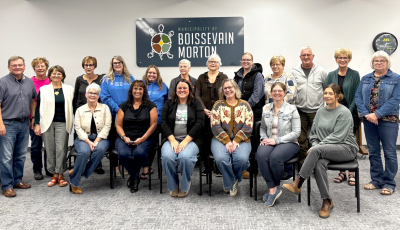
Although numbers continue to drop slightly each year, those involved in Donor’s Choice in Boissevain, and the organizations collecting the money, continue to find the effort worthwhile.
The annual disbursement was held on Monday, October 19. The 26 charities on the list shared a $53,917 pot. This was down just over $2,000 from the $56,000 collected in 2025. Donors Choice Chair Barry Lamb acknowledged the slight drop, but said the board was still happy with the results.
“We’re still very pleased with the generosity of Boissevain-Morton citizens,” Lamb said. “We topped the $50,000 mark. The last two or three years has seen a consistent drop $2,000-$3,000 a year. As I’ve said in the past, it sometimes just takes one donor to leave the community and that can diminish the money coming in.”
Lamb said there were many possible reasons for the donations going down. For one, there is a fair bit of economic instability, and no one is safe from increases at the gas pump or grocery store. As he said “disposable income is not so disposable anymore”. Also, in Boissevain-Morton, there have been a few special projects going recently. He pointed to the ongoing playground project at Boissevain School as an example of a very worthwhile effort that has been grabbing the attention of the community. There is also the ongoing work collecting funds for a new arena. These are important local projects that people have been sending their charitable dollars to.
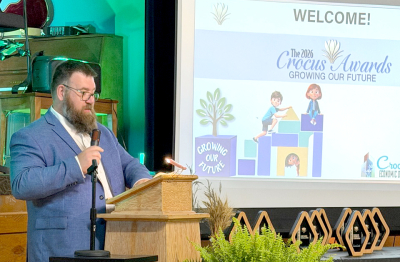
A community development board serving three municipalities paid tribute to many of the people who make their area go and grow at the beginning of the month.
On October 3, the Crocus Country Economic Development Corporation had its second annual Crocus Awards Night in the Pierson Community Hall. With the theme “Growing Our Future”, board member Cindy Horrigan explained the idea of the awards is to “celebrate the businesses, organizations and people who make Crocus Country a great place to live, work and do business.”
“In a rural region, much of the work that keeps our communities strong goes unrecognized: the business that has served families for generations, the employee everyone relies on, the volunteer who is always there. The awards give us a chance to say thank you publicly and to show what our region has to offer,” Horrigan explained.
Horrigan said the idea for the awards came from two community-minded individuals. Camiel Serruys is a Crocus Country Board member and Terri Alphonso is from Studio T Video Creation and Design, who is contracted by the corporation to do marketing and promotion.
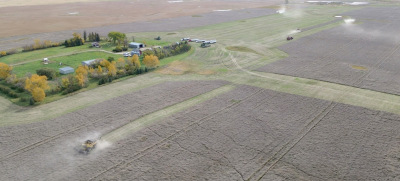
Although it may have come later than originally planned, the harvest for the Boissevain-Morton-Whitewater Growing Project will once again help those in need around the world.
On October 9, seven combines and eight trucks hit the field at Fairfax. According to Mitch Bohrn of the BMW board, they found a day of opportunity amid questionable weather, and were able to take advantage of it.
“The harvest was great,” Bohrn stated. “It was a little later than we had hoped, but this has been a tough fall for everyone. We had a good day, and people were able to get out and get it in.”
The crop this year was canola. It was chosen for crop rotation reasons. Bohrn said it looked good. Some canola in the area had been tamped down due to rain, but theirs looked better than most. The field also was dry enough to do the work.
Usually, the project’s harvest day is started at noon with a lunch and then the equipment hits the field. This year, they started at 10am, with the harvesters coming in for lunch, and then finishing up after.
“It made for a shorter day, and we knew there was weather coming so we wanted to get done before that.”
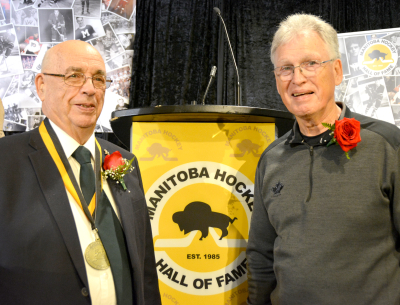
Two famous names in local hockey were given the highest honour in the sport in Manitoba this past weekend.
On October 3 at the CanadInns Polo Park in Winnipeg, Bob Caldwell of Deloraine and Ivan Strain of Boissevain were among the Class of 2026 for the Manitoba Hockey Hall of Fame, both impacting the sport in different but equally important ways.
A retired high school teacher from Deloraine, Caldwell has been involved in hockey for more than four decades. His coaching career spanned a wide variety of ages and levels, from U7 to NCAA to international hockey, impacting players and the game along the way.
He focused on “repetition, self-discovery and enjoyment” and not only coached, but also helped develop coach training. Caldwell helped create Canada’s National Coach Mentorship Program and was a coach mentor with Hockey Manitoba, holding coaching seminars around the country.
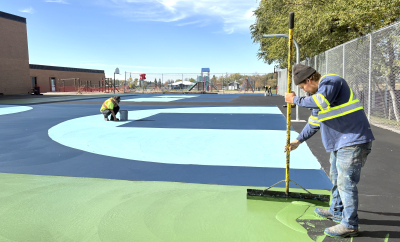
The second phase of the Boissevain School Playground project is nearly complete and planning is moving forward for the third and final development.
Perhaps calling the new work on the north side of the school a “playground” is a bit of a misnomer. The basketball court and pickleball court is aimed at the high school students as well as the public at large. However, it is the second part of the Boissevain School Playground Committee’s commitment to upgrading the area for all to enjoy.
Committee Co-Chair Heather Janssens said they were planning to get the practical work done this summer, but Mother Nature got in the way. However, JCI out of Brandon was able to get out early in September and the work has gone quickly.
“They’re getting some colour on there now,” Janssens stated. “We were hoping for the first of July, but once they were able to get out there, they moved quickly.”
There is still work to be done, and Janssens said she did not want to put a completion date on. The backboards and nets need to be put on the basketball side, the nets on the pickle ball courts, laying some lines down, and various other jobs need to be completed.
The project was called “Create a Court”. Built on the old tennis court area, the idea was to create something that would give high school students, who are often overlooked, a place to go out and get exercise while enjoying the outdoors.
“The space was not getting used, and now once this is done, it can be used all the time.”
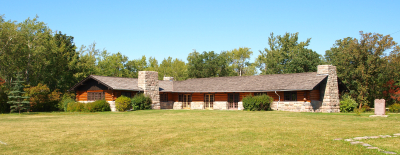
The International Peace Garden will be celebrating the 90th anniversary of its earliest structure by giving it the face-lift it needs.
The CCC Historic Lodge will hit that birthday in 2027, and according to Peace Garden CEO Tim Chapman, this important structure needs some work.
“The lodge will be 90 years old next year,” Chapman explained. “Its bones are in good shape, but it needs some work. We want to make sure it is as up to date as possible.”
The lodge is not only historical for the Garden, but part of a larger story. The “CCC” in its name stands for the Civilian Conservation Corps. This was created in the depths of the Great Depression by newly elected US President Franklin D. Roosevelt. Like other related agencies like the Tennessee Valley Authority, the CCC was created to give jobs to the great number of unemployed under the New Deal while developing key infrastructure. The CCC focused on areas like roads, bridges and parks, which is where the Peace Garden fit in.
As Chapman said, about 200 members of the CCC worked in the Garden from1934 to 1941. As well as the lodge, completed in 1937, they also built roads, fire pits and the lake later called Lake Udall. Although it was an American government project and therefore only worked on the south side of the area, they did use lumber from the Duck Mountains for the building.

A talented Boissevain student athlete will be participating in a prestigious hockey coaching program this year.
In late September, Hockey Canada and U SPORTS announced the cohorts of 22 participants in the 2026-27 Creating Coaches Program. Grace Glover of the University of Alberta, a Boissevain native, was one of five Manitobans who will be on the ice learning more about coaching this time around.

With motor oil in his blood, and plenty of experience, Mike Atchison found the time was right to open a garage in his hometown.
Nor-Del Ventures opened its doors on September 1. The proprietor was happy to put a dream into practice.
“This was something I always wanted to do,” Atchison explained. “I finally took the plunge.”
Atchison, a Deloraine native, said mechanics was something that was always a part of his life. His father Dale was a mechanic, and so he grew up around vehicles. He began in the trade after high school in 2001 at Maxwell Motors, where he worked until 2016. He later spent time at RC Auto & Repair in Hartney. He said it was time to go on his own.
“Sometimes you just have to go for it.”