
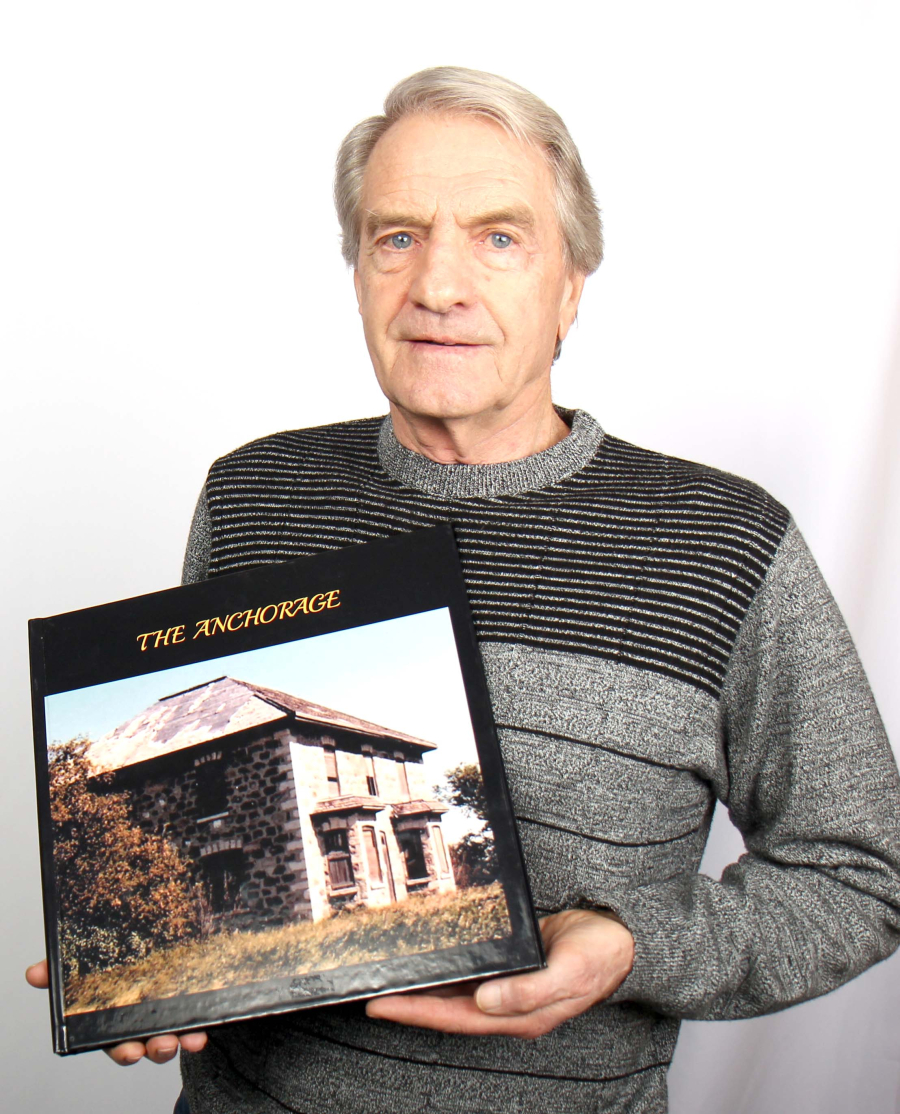
The Anchorage was built by William Moore, an old English sea captain in the Allan Steamship Line on 3-3-20 WPM. One of his sons was sent to Canada to find a suitable location and he chose that one in the old Richview District. Captain Moore did not see the property before purchasing. It was built of fieldstone, limestone, sandstone and granite in 1898. It had a balustrade platform, or “widow’s walk”, which allowed the captain to spend time on the “bridge”. He also had a flagpole where he flew the Union Jack on British holidays.
When the captain died, the house was turned over to son Charles, and it remained a family residence until 1930. It was not used regularly as a residence after, although it was sometimes the home of Richview School concerts. It was later used for a granary. Engbrecht said the house is certainly worthy of the attention of future generations.
“It was a landmark. It was a place where people had to stop in and have a look because they could see it from #10 Highway. People only lived in it for half its lifetime. It just had a presence about it.”
For Engbrecht, The Anchorage is familiar territory. He grew up in Richview, and he and wife Betty purchased the Eaket house from Bill Eaket, a former Morton reeve in 1969, raising their family there. The Anchorage was just to the east of their home and on the property they purchased. He said both he and Betty wanted to purchase the land where the two houses were on. When he was a teenager, he would see the house and the old staircase and just imagine the ladies of the day coming down ready for a dance. There was a magic and magnificence to it.
At one point, there was the possibility of the house being saved and perhaps made a museum. The Engbrechts called the province in to look at it in 1973, but a report by the government pointed out it was beyond repair, unless it was torn down and rebuilt, which was expensive. As it was, there was a liability issue for the landowners. The house was torn down in 1976. The Engbrechts were able to make use of some of it for their own renovations. Around 500 blocks were used, some in the yard and some around the windows in their home.
They were also able to use other parts, like the floorboards, for different pieces of their house. There is definitely a presence of The Anchorage in the Eaket house. In fact, the Engbrechts’ named the decorative garden in their yard Anchorage Gardens.
The book includes the study done by the government about the house, as well as articles by Ken Storie of the Turtle Mountain Souris Plains Heritage Association and by Peter Neufeld. The Neufeld article is particularly interesting, and it is well researched, including stories of Captain Moore’s time at sea, and the sad fact he only lived in it for a few months before his death in 1899.
Engbrecht also includes his and his family’s stories in relation to The Anchorage.
There are pictures from old school concerts, pictures prior to the demolition, and during, as well as blueprints of the building. There are also photos of the work done in the Engbrecht house. The two houses tie together, and the book reflects that.
Overall, the whole property is full of personal history. The Eaket house was where he went for piano lessons, and as the owners were the only people with a television in the area, where he and others in their community went out watch NHL hockey games. Both stone houses are close to his heart, which made the use of materials from one in the other, and the making of a celebratory book, so important to him.
Some corrections must be made to the book, so a new copy will soon come. Engbrecht is planning to donate that copy to the Boissevain-Morton Library, with the idea the public can look inside the building if they are interested in a fascinating subject.
He is working on other books, including local history. Engbrecht is thankful to an unnamed neighbour for teaching him the computer program that made this work possible. He feels there is a need to keep these stories alive, including those of the old stone houses.
“We would never be able to renovate our stone house without the Anchorage,” Engbrecht stated. “From the book, I just want people to get a connection to history.”
by PAUL RAYNER, Recorder staff