
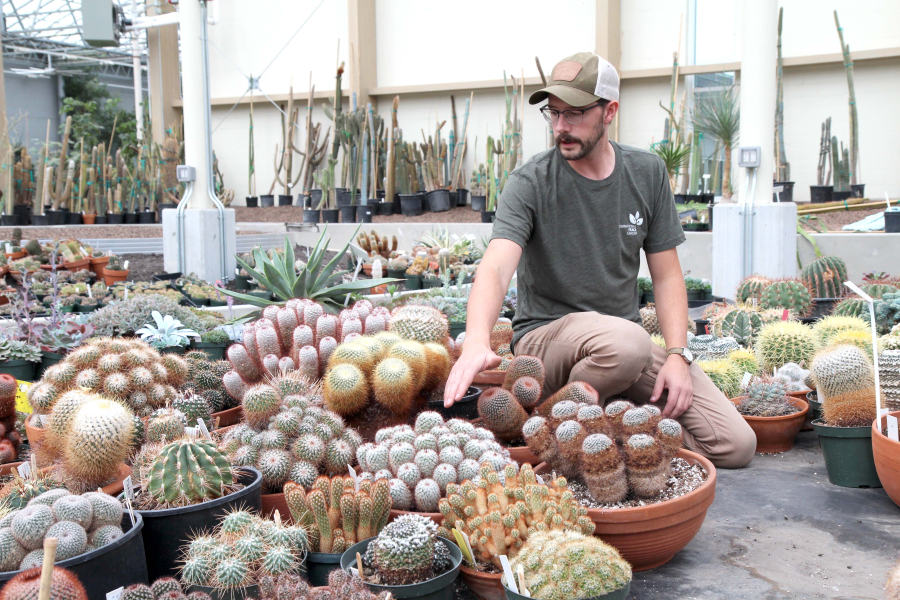
Jonah Neufeld, the conservatory horticulturalist, continues to work on the final touches of the project. Right now, they are bringing in the cacti to their new home.
“We’re making good progress,” Neufeld said. “It’s kind of a two-tiered planting system. We’re doing in-ground planting, planting the cacti directly into the soil. This is with our larger cacti and our larger succulents as well.”
He said in that section, they had completed about a third of the planting. Also, some of the smaller ones are put into pots, and they have just started on that part. They are using more clay pots than plastic, as the cacti react better to it.
“We still have a fair amount to do, but we’ve been trucking along on that. Sometimes it is a game of inches. If a cactus has to move four inches one way, we’ll stand back and look at it and move it.”
He added they do have to plot a little by seeing how big a cactus will get. They need to account for that when they are doing the spacing. As well, when planning out with the architect, they had to make sure the ceiling fans would not clash with the taller plants.
“We are trying to account for all of the future growth,” Neufeld explained, “especially the height.”
He said they are all excited about the new building. The new display area is larger, allowing for a better space for display and future growth. It is brighter, but the shades in the ceiling also allow for the plants to be out of the sun in the summer afternoons and also retain heat in the winter evenings. The wood beams from Western Archib in Boissevain add a stately beauty. They have a brand new system for clean water they can adjust to the needs of the plants, and the walkways and seating areas are great for visitors.
“We really wanted an area where people want to linger and I think we nailed it.”
The soil used for the cacti is custom made by the hand of head horticulturalist Johannes Olwage. Neufeld said Olwage did a lot of research and discussion with experts and came up with a great mixture for their plants, using components from all over.
The rough numbers of plants right now are around 4,500, with about 4,000 unique species. They have some “backup plants”, but for the most part they are unique. The collection originated with Don Vitko of Minot, who was very interested in all kinds of species from all over.
The cacti come from different areas, and are displayed with this in mind. They flow from North to South America. Neufeld said the ranges for the different types do overlap and so they try to organize it in this way. Overall, they will move from north to south – basically from Arizona through Mexico, including some of the tropical species, all down through South America.
“We’ve tried to start north and then move south, we’ve tried to keep them in location and groups.”
Neufeld said the differences between the physical sizes of cacti have less to do with the north-south continuum, but how arid the land is. The drier it is, the smaller the cacti are. For example, the ones from the highlands of Peru or Bolivia are very small as it is very dry. Those in more tropical areas will grow taller.
They are just starting to add cacti and succulents from other areas like Africa and Yemen. The plants have a big range, with some species being seen as far north as Fort McMurray, Alberta.
Neufeld is the only member of the team who works in the conservatory full time, although Olwage and others have certainly been working hard on the present project. He started at the Peace Garden in 2012. At first he was mostly in the sunken garden, but would hop over to help Olwage in the conservatory. Over the years, the ratio of time shifted to the conservatory. He spent time in university, but by 2019 he was full time conservatory only.
With experience in his father’s greenhouse, moving over to the garden was a natural. He has learned a lot from Olwage, who loves sharing about the plants, and continues to enjoy adding to his cacti knowledge.
“I think that is why I’ve stuck around,” Neufeld explained. “I continue to learn. During this move, there has been a lot of research on these cacti, which has been a lot of fun.”
The bulk of his learning has taken place at the garden. How much water does a certain cacti need, which ones need to be out of the sun, all of this knowledge is key to becoming something of a “cactus whisperer”. From seeing the plants every day, you get to learn when something is wrong with them. The big thing is to watch the amount of water you give them. They are mostly not too thirsty.
by PAUL RAYNER, Recorder staff
The plan is for an official opening on December 9. Chapman said they are bringing Santa out for the day, and they are planning more activities around the event. This could become an annual pre-Christmas celebration. The new conservatory will be part of the Peace Garden’s expansion into more of a four-season centre. People can go out on the ski trails, then come in to warm up. It is perfect for its geography.
“Winters are long here,” Chapman stated. “It is nice to have spaces that are green. Our local communities can come in and enjoy a warm climate.”
Neufeld said he too is looking forward to showing off the work they have done. The plants are coming in and they will have everything ready for the public. He wants the public to see what he enjoys so much.
“It is fun actually,” Neufeld said. “These plants are a lot of fun. They are a challenge, they can be painful, but they are fun. They all have a lot of personality. I smile a lot when I work with these plants.”