

Cherry Creek Place has developed into one of the best projects Boissevain has seen in its recent history.
The active living facility opened in the summer 2021 after many years of planning, fundraising and practical work. In 2024, everything continues to move well, with all indications this will continue into the future.
“We are full, all 35 units, for several months now,” said manager Heather Garden. “Weekly we get more and more inquiries. We have seven or eight individuals or couples who are ready to move, on top of a very long, long waiting list.”
Cherry Creek was developed as an active living home for seniors, arising out of an original desire to replace care home Westview Lodge. Located on Mill Road, the idea was to offer a place for people who were still wanting to live on their own, but wanting to do so in a space with fewer responsibilities.
“Our goal is to offer seniors a place to live in their community independently.”
They serve two meals a day, with residents responsible for breakfast. As they are active people, they are on the go, but they are good at letting the kitchen staff know if they will be away for meals. They do deliver meals to suites, which can happen if a resident has guests, a major sporting event on television, or may be under the weather.
Cherry Creek does some laundry like sheets and towels, with each floor having a laundry room for residents to do their clothing. There is also light housekeeping once a week, and they take out their garbage and recycling daily.
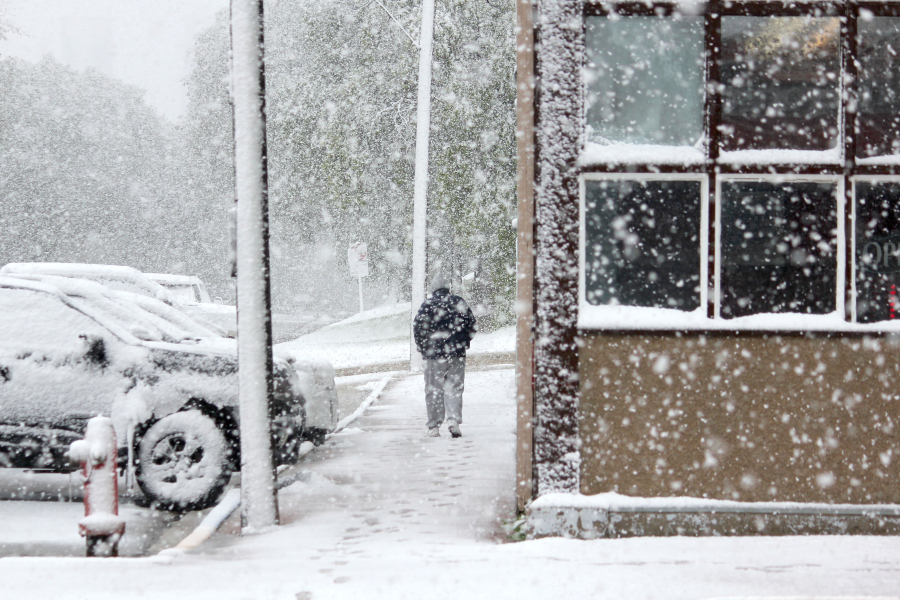
The snow we did not have during winter came to us last week, the latest in recent memory. when we definitely did not need it.
In what has been a wet spring, Friday, May 24 was supposed to have rain with a bit of snow. Instead, starting early in the morning, the white stuff came all day in heavy, wet clumps. The temperature did not dip below zero in many communities, which limited the damage somewhat, but in other areas, it had a very bad impact.
At the International Peace Garden, the heavy snow was quite damaging. Although we often do not think of the Turtle Mountains as being a high elevation, it is enough to make an impact. CEO Tim Chapman said the attraction along the Canada-US border suffered from the storm, saying they had about eight inches of snow.
“It’s hard to say how much damage there is right now,” Chapman said. “The snow was heavy and wet and it broke quite few trees. It was definitely pretty extensive, especially with the trees along the drives.”
Maples planted last year were hit hard with some dead now. Others had branches broken off. They did have to close up the north end for a while, but overall were able to stay open, as the snow was melting the whole time. In fact, Chapman said there were a couple of people from Florida at the garden, and the weather definitely made an impression on them.
“They were a little surprised. If you look at the bright side, it was green under the snow.”

If the province is determined to force a single mill rate on amalgamated municipalities, the council for Boissevain-Morton is equally determined to make sure its impact is lessened on rural ratepayers.
At a public hearing on May 16, they presented By-Lay 2024-03, a proposal to create a system of special service levies, which would prevent a shift of taxes from the urban ward to the rural. A fairly large crowd was on hand for a presentation by Head of Council Judy Swanson and CAO Leo Poulin, who outlined the reasons for the changes and their impact.
The single mill rate has been a controversy since the province announced that municipalities under 1,000 people would have to amalgamate more than a decade ago. Although the new entities could run separate rates, under which taxes are collected, for different wards for a period of time, one that became a decade, eventually all would have to adopt one rate per municipality at some point. The controversy is that municipalities often have rural and urban components. Services in the urban are not always used by rural residents, and so it is felt they should not have to pay for them. As well, rural property is worth more, so a single mill rate would mean they would pay more for services they did not use. In Boissevain-Morton, the change would be acute. A single mill rate would see rural taxes up by 24.4%, while urban would drop 21.1%.

When Terry Fox was four years old, he tried building a pyramid with little wooden blocks. As his mother watched from the kitchen, they would fall, and he would build again. No matter how many times, he would never give up until he reached his goal. This would be the theme of his life, something he would reach for over and over, something that would make him the greatest Canadian hero.
This was one of the stories Fred Fox, Terry’s older brother brought to Cherry Creek Place in Boissevain on May 15. Invited by the local TOPS organization, Fox brought family pictures, stories of Terry’s life and his Marathon of Hope in 1980, a journey those of age remember well, and one that continues to this day.
As Fox stated at the beginning, a trip to this area is special, as his mother Betty was born in Boissevain, and raised in Melita. As he explained, it was his mother who took on the mantle of travelling to spread Terry’s message after his untimely passing in 1981.

Although the where and how much is not yet settled, Boissevain-Morton is planning to pay much needed attention to the urban streets and rural roads in 2024.
Living in our area might have certain benefits, but keeping roads and streets in good condition is not one of them. Rain, snow, freezing, hot sun and a variety of all of these play havoc on the modes of transportation, which make keeping them usable a challenge for all municipalities. In Boissevain-Morton, that is more than obvious. In particular, the streets in town have a Swiss cheese look in many places, and woe to the driver that forgets where the frost boils are.
The municipal council is in the middle of budget deliberations. Head of Council Judy Swanson said they are in the preliminary stages of setting the amounts they will spend in the two areas of the municipality, but know they will need some work.
“There are places that need it, and we’re well aware of them,” Swanson said.


A new project to engage younger people in the International Peace Garden has already brought in students from Boissevain School.
The Grade 9 and 10 Metal Works class has been working on story boxes to be used in the beds at the Garden. Tim Chapman, CEO of the Peace Garden, said this year they were looking to grab young people at the border attraction.
“We really wanted to make the summer engaging for all ages this summer,” Chapman explained. “We wanted to put something at or near the various flower beds, and being able to partner with Boissevain School really fits what we wanted to do. We wanted students, parents and everyone to see what the students did when they visited.”
Chapman said Education and Volunteer Coordinator Deb McCallum reached out to the school with an idea of having them involved. The horticulture team put together stronger plans of what the beds would look like, and then everything took more definite shape. The idea is for story boxes to be filled with books and placed at the different flowerbeds.
Chapman said they are trying to promote children’s reading as a theme this year, so the story boxes fit. There will be different levels featured. For younger ages, books found will include Clifford, The Cat in the Hat or Curious George. For older readers, they are planning on having Lord of the Rings or Harry Potter books, hopefully the whole series. Other books might feature nature topics, which is something the Peace Garden highlights.
“There will be a good variety of themes and topics.”
The kids can take out the books to read while they are visiting that spot in the garden. Obviously the larger chapter books will not be completed during their stay, but the lighter youth books could be, and this could make a nice family moment.
The books are coming from donors and supporters who have been going to their Amazon list to donate. Chapman said the response has been very good to this initiative.
As well, they are planning to have a Story Stroll by the play structure recently added by the Conservatory. They received a grant, with the plan to use the book “Walking Together” by Elder Dr. Albert D. Marshall and Louise Zimanyl. It follows a group of children connecting to nature, and explains the Indigenous concept of Two-eyed Seeing. There will be 12 stations, with a couple of pages of the book in each, to serve as a learning tour in their animal themed playground. Although this project will only last for 2024, the hardware used will stay in the ground, possibly for use with another theme in the future.
The Peace Garden is also inviting local libraries to come out this year during their regular story times, to check out the area, to combine reading with what the Garden has to offer.
Chapman and McCallum visited Boissevain School to connect with the students about the project on Thursday, May 2. Prior to the visit, the CEO said he felt the class was getting close to completing the boxes. The hope was they would be able to get them into the ground at the various beds in the next few weeks. They are not in too much of a hurry as the flower displays are not normally in full bloom until later in the summer, but there are people in the local area that visit early to see the seasonal changes. They would like to have them up for those people to look at while the beds develop.
Wood and supplies for the project were donated by Goodon Industries and the Boundary Co-op. Chapman gave credit to Principal Landon White for his efforts in promoting the story box idea. Chapman thinks it is great that the students in Boissevain are able to help out, and wants them to know they are assisting young people catching the reading bug in both their home community and others wherever the Garden attracts visitors. This kind of connection with schools and communities on both sides of the border is exactly what they want.
“Hopefully, this snowballs,” he stated. “We hope other schools see the opportunity to engage in a variety of ways.”
“This is one idea of many. There is never a shortage of things we can do with students.”
by PAUL RAYNER, Recorder staff

Build it and they will come. It is not baseball and “The Field of Dreams”, it is a recording studio. The idea is the same, provide the opportunity and the people will follow.
Musician Robert Critchley is a relative newcomer to the Deloraine area. He and his wife Dawn moved to the Turtle Mountains, close to Lake Metigoshe over a year ago. His daughter Bethany and son-in-law Chris Paul arrived earlier to the area, making their home in the area and establishing a contracting business Choice Home Improvements. The Critchleys felt the time was right to open a recording studio in their new home.
In his musical journey Robert followed in his brother Greg Critchley’s footsteps and attended Mohawk Music College in Ontario where he studied for a degree in Commercial Music. He has been writing and performing music since the late 1970s when he was with a band called Metrognome that played in the Niagara region of Ontario.
“I met my wife Dawn in a church in Niagara Falls where she played the trumpet in a modern church band. It was in discovering modern church music that I found an inspiration for writing choral song and anthems with attention to singable melodies,” he said.
Two songs written during that time include “What A Faithful God” and “My Troubled Soul,” which have traveled around the globe and are published in modern hymnals worldwide in many languages. A highlight for Critchley was when British R&B recording artist Jocelyn Brown recorded “My Troubled Soul” at Abbey Road Studios (studio home of the Beatles) in 2008. At this time he also learned the joy of mentoring others in their music and creativity and recorded an album in Nashville entitled “Harvest Of Hymns” with producer John Hartley. Besides writing and producing music, Critchley became an itinerant worship leader from 1985-2003.

This year marks a very special occasion for this paper – in October, The Boissevain Recorder will celebrate its 125th anniversary. It is one of those rare birthdays many people can take credit for.
There are the staff members, past and present, who put out a paper for the nearly 6,500 weeks of The Recorder’s lifetime, the people who make the news and the people who read it. The beauty of being in a rural community is that these roles often overlap.
This publication marks another anniversary. April 19 marks the 25th year that I have been editor-publisher of The Recorder. It is a milestone in my career, but my relationship with the paper stretches back even further. It begins over four decades ago in July 1980. I was seeking my first after-college graduation job and I was sitting across a desk in a job interview with Miles Phillips, editor-in-chief of The Boissevain Recorder.
Phillips offered me a full time position at the Recorder and on July 16, 1980 my career with The Recorder began at a starting wage of $3.50 per hour.
It is ironic to look back knowing my life could have easily went a diffferent route as I had another job offer with the Royal Bank, who were opening a new branch in Deloraine. I was not even 19 years old and still undecided what I wanted for a career, but saw the newspaper as an opportunity to be creative and to meet a variety of people. Secretly I thought it might provide a stepping-stone to work in a big-city daily someday. As it turns out, this community stole my heart.

A partial solar eclipse was visible over Manitoba on Monday afternoon, April 8, when the moon slowly passed in front of sun. The eclipse lasted a little over two hours from approximately 12:50 to 3:00pm with around 50 percent of the sun being obscured by the moon at maximum. Although a small track through eastern Canada experienced a total eclipse, Manitoba was outside the path of totality.
The next total solar eclipse visible in the prairies occurs in about twenty years. On August 22, 2044 Manitoba will again be outside of the path of totality, but not by much. Weyburn’s current city limits will lay only kilometres outside of the path. In Southwestern Manitoba, a little more than 99 percent of the sun will be obscured minutes before sunset. Only a thin sliver of the sun will be visible just above the horizon with the sky darkening a noticeable amount, only for it to re-brighten again into evening twilight. Not quite comparable to totality, but still a spectacular thing to witness.

It is hard to imagine how many lives a paramedic touches during their career whether short lived or long term.
Bev Huys of Deloraine made a difference in many lives during her 26 years of service as a paramedic. It all started in 1998 when she was a young mother of two, having moved from Portage la Prairie to Goodlands. In a casual conversation with Glen LePoudre, a paramedic from Deloraine, Huys mentioned she had worked as an Emergency Medical Responder (EMR) in Portage but had let her licence go. LePoudre encouraged her to re-apply with the local health region.
“It has been my dream job, something I wanted to do since I was a little girl,” she said.
Huys began her career on February 28, 1998 as an EMR. A couple of years later the title was bridged to become Primary Care Paramedic (PCP).

By the end of the month, an important service club in Boissevain will see its work come to an end, with a strong legacy remaining.
Giving away what is left in its bank accounts, the United Commercial Travelers Boissevain Council #940 is contributing to the community one last time. Started in 1997, the organization has been a major part of the area, quietly giving to Boissevain-Morton for nearly three decades. Shutting down now, the UCT is seeing the impact of changes within and without their club.
Charter member Wendy Clyne said the timing was natural for the decision as it was their year-end.
“We’re all getting older, all the members we had,” Clyne explained. “We were down to around 20 members, and maybe 12 attended meetings. We had some members who didn’t attend meetings who would come and help us, but as for taking on the roles in the organization, we’d all done it a dozen times. It comes time.”
She added they were also a little limited in terms of their fundraising. The UCT was famous for working the lunches and pies at Wright’s auction sales. They were getting older, so this was more difficult, and Wright’s, due to COVID, changed how they did their sales. Clyne said they chose to try doing service in the community in lieu of fundraising, and did so, but the time had come to move on.

With help from an important community organization, a new element was added to car racing for young boys in Boissevain.
The boy’s club at the Mennonite Brethren Church held their annual car races and rally on Sunday, March 17. According to one of the leaders, Duane Thiessen, the event was a success, especially with a new piece of equipment.
“It went really well,” Thiessen stated. “The new track worked great and everybody had a great time.”
The club, which races wooden model cars, was able to pick up a new aluminum racing track this year. Theissen said they had been running the cars on an old wooden track that could be as much as 40 years old, used by other community clubs before the youth group. It was past its due date, and in need of replacement.
In September, there was the annual event at Boissevain School where kids’ groups collect registrations for the upcoming year. It was then that a form from the Boissevain & Morton Foundation was dropped off. The group decided they could not go wrong by applying for a new track. Thiessen said they applied for $1,200 for the new piece of equipment, not knowing how much if any they would receive. The total was $1,195, which they discovered when the cheques were handed out in November.
“We had no idea until they had the meeting at the curling club. We were very pleased. We’re very grateful to the organization.”
The new track, picked up from Iowa, not only runs very smoothly. Connected to a laptop with appropriate software, it can track the cars running in miles per hour. Using measurement techniques, it can turn the wooden cars to NASCAR on screen and sort of pro-rate their speed. Thiessen said the fastest car in the tournament was averaging 200.11 miles an hour. This feature makes the races that much more exciting, particularly as some races had the first to third cars only a mile and a half different in speed.
“The kids were super pumped,” Thiessen said. “They were cheering for the cars, running up and down the track. It was great.”
They are also able to easily calibrate points, and set up the races. Overall, it makes the rally that much more enjoyable.
Thiessen said the boys, in grades two to six, had nearly 40 entries show up for the rally. Each car was able to race in 12 heats.
The cars begin as blocks of wood. The participants make a car out of them, and weight will be added if needed to bring them to specifications. They also decorate them themselves, with Thiessen saying there was an array of different designs, some more elaborate than others. This is similar to Cub car races from an earlier generation.
The club meets Wednesday evenings starting October. They play games and have a storytime, and also do projects. This past year, with wood donated from Springhill Lumber in Killarney, they made functional gumball machines. They were a lot of work, but the kids were able to get some experience with handsaws and power tools. Thiessen said he is not sure why, but the club has become very popular recently, with around 45 boys registering the last three years.
The race day was their last meeting for this year, with a windup party also held.
Thiessen said the new track is a great asset for them. It can be run without the laptop, so he can see other groups getting some use out of it. Again, they are thankful for the assistance they received from the Foundation and feel they have something to benefit kids in the community for a long time.
“People who saw it said it was very impressive,” he stated. “Hopefully, the track will be well taken care of and will be good for decades to come.”
by PAUL RAYNER, Recorder staff

Expanding their academic knowledge is only one of the benefits of participating in the Boissevain School Science Fair.
The annual exhibition was held in the south gym at the school on March 8. Students were able to present their projects to their peers, teachers, judges and the larger community. Grade 5 and 6 teacher Bob Birch said there were 71 projects presented, with 100 students participating, similar to last year. He added he and co-chair Hannah Beghin, who teaches the same grades, were pleased with the result.
“Hannah and I were very happy with the day and the number and quality of projects presented,” Birch explained. “There was plenty of excitement, the community support was excellent, and the day ran smoothly.”
He said the fair is open to students from Grades 1-12, although Boissevain only had projects through Grade 8. It was enough to fill the gym with interesting discoveries. As Birch stated, the purpose is to instill a love of learning in a subject he teaches himself.

New enthusiastic board members and volunteers are getting Beckoning Hills Museum in shape for a 2024 opening.
The museum was turned over to the Municipality of Boissevain-Morton a little more than a year ago, and due to different factors, was not open in 2023. A meeting was held last fall to try to gauge interest in restarting the attraction, and many people stepped forward. Since that time, workers have been heavily engaged in getting the Mill Road museum back in shape for sharing the past with locals and visitors.
Board Co-Chair Sandra Pearce said the work started pretty much right after the public meeting. The board met, took a look around the building and discussed what they wanted to do going forward.
“We discussed what we wanted to do to get it open this year,” Pearce stated. “Long term, there is still some discussion.”
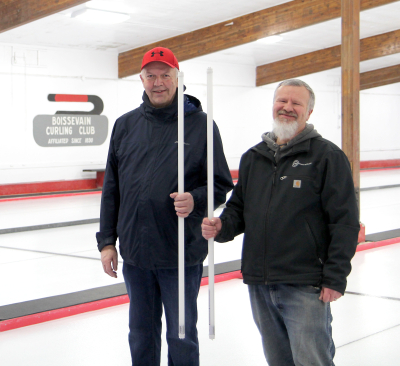
By the turn of the season, several local winter recreation facilities should have new, more efficient lighting with some help from a dedicated organization.
In Boissevain and Elgin, skating and curling facilities are receiving LED lighting thanks to Efficiency Manitoba, a Crown corporation committed to achieving significant annual energy savings by offering programs and services to Manitobans. Under a Community Rink Lighting Initiative, these facilities were able to access $2 million in funding for up to 100% of lighting equipment and labour costs.
Copperman Electrical in Boissevain is one of the suppliers involved in Efficiency Manitoba. Marc Loewen of Copperman said they receive emails about different programs under Efficiency Manitoba, and in the early fall, they received word of the Community Rink Lighting Initiative. He said he did more research and found it applied to curling as well as skating rinks.
“I found it could cover 100% of a project cost, including labour,” Loewen remembered. “We thought ‘whoa, this is a significant program.’ I went looking around for organizations that were interested.”

Daycare wait lists are a concern for many families. With both parents working being the norm, childcare is a top priority. Available spots vary among facilities.
Wee ‘R’ Special Daycare in Deloraine has four infants and 16 regular spots. A recent surge in births has caused a waiting list and parents seeking childcare spots in neighbouring communities.
The daycare board in Deloraine has received many concerns from parents about the waiting lists and lack of after school programs.
“It was time to have a conversation about childcare options. The board felt we should do our due diligence and address the concerns,” said Courtney Sunaert at a town hall on February 12 at the Prairie Skills Building.
Sunaert, along with board members Britney Forsyth, Marlee Langdon, Britney Stovin and Dani Bell delivered a well-prepared presentation.
They began with the “knowns”, which included enrollment, funding options, expansion needs and before and after school care.
More...

A lake that may not really be a lake, one that can be dry or overflowing, but that always has an impact on farms and land around it, is the subject of new film by a local historical group.
The Turtle Mountain Souris Plains Heritage Association is working on a short film on Whitewater Lake. The lake, located between Boissevain and Deloraine, has almost a strange, mythical status in the area, with memories about it vastly different depending on what era one lived in. It makes for an interesting story, one that fit within the organization’s bounds.
“Whitewater Lake comes up in conversations with people and with our (municipal) councils,” explained TMSPHA member David M. Neufeld, explaining the decision to make a film on the subject. “There is some frustration in Deloraine and Boissevain with the inability to solve the problem with it. It seemed to us it would be helpful to make a film, to have conversations and listen to different perspectives.”

Local firefighters took advantage of an opportunity to add to their winter rescue skills last weekend.
Members of the Deloraine and Boissevain-Morton Fire Departments took to the classroom in the Deloraine-Winchester Municipal Office and the water at the Turtle Head Creek Dam by the golf course to work with Trans-Care Rescue Ltd. of Langham, Saskatchewan on February 3 and 4. They worked on skills related to helping victims out of freezing water and caring for them once out. Eight members of the Deloraine department participated, with two joining from Boissevain.
Andrea Mustard, along with Logan Graham, made the trip over from Boissevain. She said the course was organized from the Deloraine department, and they joined in.
“With our department, along with all departments, we try to continue our education and learn new things and skills we can use in our area,” Mustard explained. “This course came up, with Deloraine bringing the gentleman out, and there was room for some more, so a couple of us from our department were able to spend the weekend along with members of the Deloraine department learning.”

Canada Border Services Agencies (CBSA) and Manitoba RCMP say they have made the largest narcotics seizure in prairie history, over $50 million in meth.
CBSA and RCMP held a press conference in Winnipeg on January 31 and said the haul was found in a semi-trailer bound for Winnipeg on January 14 at the Boissevain border crossing
Officers discovered and seized 406.2 kg of suspected methamphetamine, approximately four million illicit doses valued at over $50,780,000.00, following the examination of a commercial truck at the Boissevain port of entry. The narcotics were found in several large suitcases in the truck.
“This is the largest seizure of narcotics our border officers have ever made in the prairies. Thanks to their quick and decisive action, more than 400 kg of methamphetamine were kept off our streets. The accused has been charged for importation of methamphetamine valued at over 50 million dollars, trafficking, and smuggling into Canada,” said Janalee Bell-Boychuk, Regional Director General, Prairie Region, Canada Border Services Agency
The driver, identified as Komalpreet Sidhu, a 29-year-old man from Winnipeg, who was alone in the vehicle, was arrested by the CBSA and transferred to the Manitoba RCMP along with the suspected narcotics.

It is easy to enjoy Turtle Mountain Provincial Park in the winter, as this Boissevain group did on Sunday, January 21. (L-R) Ross Wilkinson, Les Houston, Milt Stobbe, Steve Cann, Rosa May, Patti Unrau, Judy Stobbe, Gene Unrau and Doug May enjoyed the warming hut at Lake Adam. As can be seen, between the bikes and skis, there is plenty to do out there. Although it was cold for more than a week, temperatures have improved and Environment Canada forcast a high of +6C by mid week. Photo by Doug Gray
Where to have fun with winter....
Winter might have come a little slowly to the Turtle Mountain Provincial Park, but the site is seeing a lot of outdoor adventurers now, with a major annual event coming in a month.
Snow sports obviously need snow, and at times this winter, this has been absent. With a dump just before Halloween in 2023, it looked like there would be no shortage. However, everything warmed up and it looked like skis, snowshoes and snowmobiles would stay in the shed. More recently, the white stuff has returned, which has meant the coming of winter fun. Casey Guenther, who operates Turtle Mountain Adventure Huts in the park with his wife Christina, said it has been a different season this year.
“It has been a challenging winter,” Guenther explained. “We thought we would be on the skis early and then the snow disappeared. It affects what folks do out there.”
The huts opened up two years ago this past Christmas. Located a short walk from the Winter Recreation Trailhead at Lake Adam south of Boissevain, there are two huts that pack a lot into their 160 foot space. Guenther said each could easily sleep five people, with a king-size bed and a double. They have a wood stove and a propane cook top, with both fuel provided by the operator. There is a little solar panel to provide electricity. Each has an outhouse, but they are close enough to the rec park there is hot water and toilets for those less adventurous. Visitors really only bring bedding, food and equipment for activities.
The huts have proven popular.