
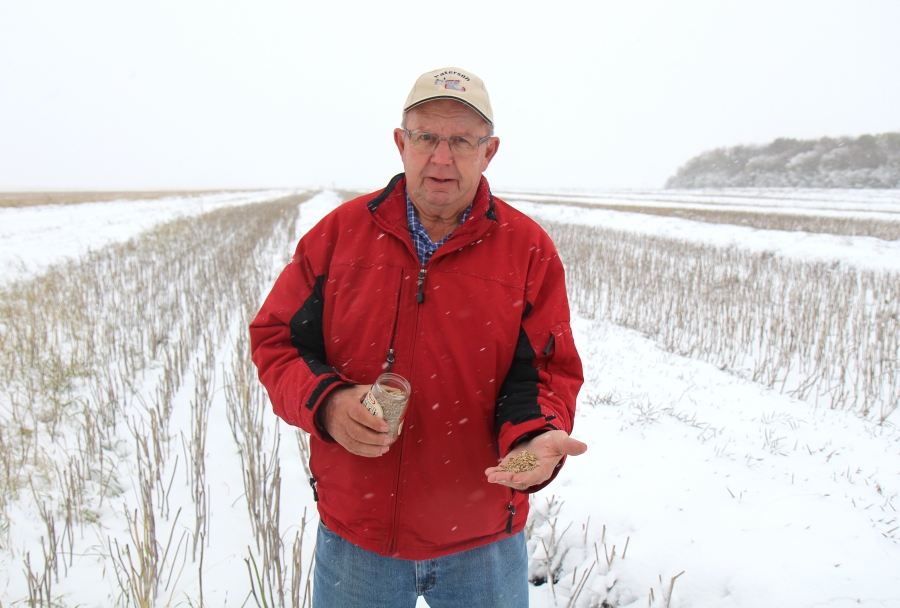
Mains said on Monday he and his family were heading back out on the land about six miles north of Boissevain. He was not sure if the fields were ready for the traffic, but they were going anyway to try to get as much done as possible. The conditions were far from ideal.
“It’s extremely wet,” Mains stated. “I don’t think I’ve ever seen a fall where the ground has been so wet. We’ve been delayed before, we’ve had rain and snow before, but never this wet, and over such a large area. We’ve had years where we were at it on Halloween, and combining into November. It was miserable weather, but not this wet in the ground.”
Mains said he has been farming for close to 60 years and has certainly seen some challenging developments. Before he was farming for himself but old enough to help, they once got snow on the sixth of October. That year, it never went away.
“It just stayed there. We combined the wheat next year, but it was no good. It was like puffed wheat. But most of it was off that year.”
This year, much of the crop is still on the field. One of the concerns is getting around to harvest it. The ground is a mess everywhere.
“I don’t think I’ve ever seen a fall where the ground was so treacherous to drive on,” Mains said. “People are getting stuck out there. I know one year, about 15 years ago, the ground was so wet people were getting stuck and had to be pulled out all the time. There is more water lying around this year and there will be lots of crop in around the sloughs they will not be able to get off.”
“It is going to take a lot to clean it up. We are leaving deep ruts, and we’ll have to clean that up by next year.”
The snow is not going to help. Mains has seen snow on the crop many times before, but if it is not too wet and it comes off, it can be survived. He remembers combining with snow on the fields in 1980, one of his low-light years.
In 1980, Mains said they had a late spring and a tough fall. They were drying crop a lot that year, into the next spring. He still has samples from that year, mainly because it was such a bad example.
“It was really bad, I’ve never seen it that bad. It is wee, wizened up wheat. It looks terrible.”
He said one of the issues with the grains is the longer it sits in the field, the more the quality drops. This year, the grain yields are good, but in some cases, the quality is dropping the price in half.
“It was an exceptionally good crop, if we get it off,” Mains stated.
Even some of the later crops are showing the effects. Mains said the corn does not look as good as it did a couple of weeks ago.
One problem they do not have is geese. Sometimes large numbers of the waterfowl can get in the way of harvest. Mains said he remembers working on fields and having the birds take off just when the combine got to them, and then going back on as soon as they had left. The geese do not come as often as they used to, perhaps due to changing crops, or this year, the fact the fields have not been harvested in the northern region, giving them no reason to come south yet.
The Mains’ have a lot of their wheat up and are working on their canola and beans. They were trying to take advantage of every opportunity to finish when they can, which means some long nights. It has been a tough year for everyone, Mains said, with the one good part is there will be lots of moisture for next year’s crop. It has been a challenge, with all of the driers running and the elevators taking what they can. If there is any solace producers can take from the situation is that really, the fall might be a little different than others, but in many ways it is more of the same.
“There really is no normal in farming.”
by PAUL RAYNER, Recorder staff