
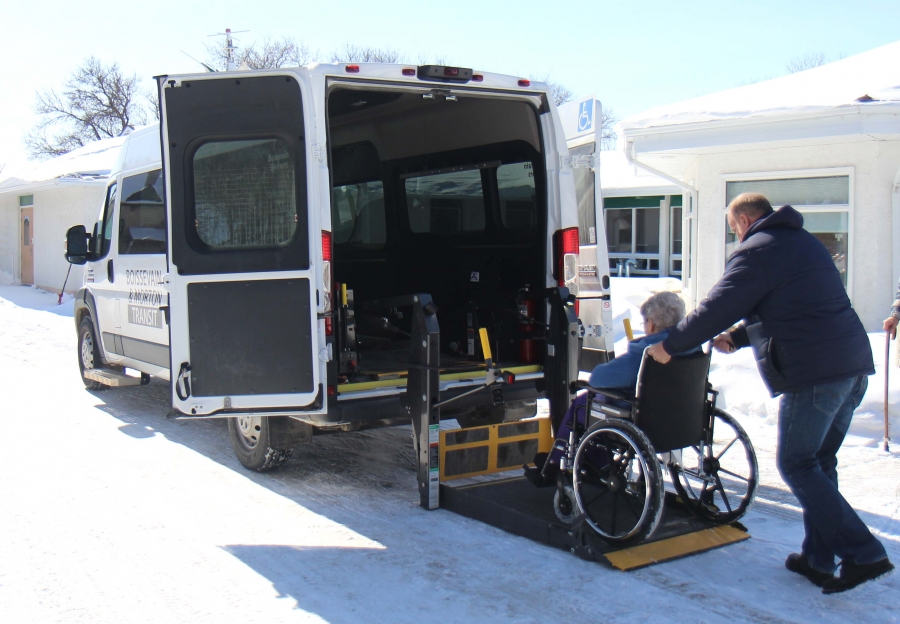
They have some possibilities for the full-time driver, but are still taking applications. Those applying need a Class 4 drivers’ license in order to operate both of the handi-vans. They are also always on the lookout for spare drivers, as they need people for holidays, or when both the vans are running. Drivers are trained on using special equipment like the lifts.
Essentially, the handi-vans are there for transporting people in and out of town. They are heavily used by people in Evergreen or Westview Lodge – where the drivers get some help in loading from the workers. They will take them on group trips or to the lab for tests. However, unlike what people often think, it is not for seniors only. Anyone can hire the vans for a ride, as Boissevain does not have a taxi service. For example, there are people who have used it for a ride to work and kids have used it to go from the school to music lessons.
The vans have taken people not only around Boissevain, but around the area and farther. They have gone places like Winnipeg, Portage, Austin, even to Saskatchewan. In the summer, the seniors’ homes use it a lot to go to the Peace Garden, and there are a lot of medical, optometric and dental trips to Brandon or Killarney.
Conway-Smith has been involved in the handi-van committee for 35 years. Originally, they only had a large van. She said over that time they have changed their mini-vans four or five times, with early ones being sold to locals like the Hand-Crafter. Most recently, they received a new van in 2017. It has a great advantage over its predecessor, as the earlier vehicle had a slide ramp you pulled out, where this one has a proper lift like the larger van. The smaller one tends to get more use, and traditionally they have changed them over every five years. This is partly because of depreciation impacting the funding they receive, and partly because repairs are expensive. They are hoping the newer model might be able to last longer. The list price for the last van was $78,000 before trade in, while the larger ones are around $200,000. The last time they bought a larger van was 2008 and it was funded by the federal government.
The service has changed over the years. They only run Monday to Friday regularly now, although people can use it on weekends if pre-arranged. If they have the proper licensing and provide an abstract, they can rent it themselves. The committee can no longer justify having a driver paid all the time on weekends.
In 2003, they added grocery delivery service, which is fairly heavily used. For some, getting their groceries delivered from the Co-op to their home is important. However, people come first before groceries and there has been talk of trying to only do deliveries once in the morning and once in the afternoon.
Dalrymple and Conway-Smith said usage of the vans is still fairly strong, but much has to do with weather.
“It seems like if the weather is tougher, then our rides are up more,” Dalrymple said. “Otherwise, people like to walk.”
“It has stayed the same the last three or four years,” Conway-Smith added.
Should the assisted living complex go ahead, there is a good possibility the demand will go up.
Although people have to pay for rides, the service does not pay for itself. They are subsidized by the municipality, who gave them $4,150 last year, and the Province, which provided about $27,000. They also received donations from the Boissevain & Morton Foundation designated funds, Masons, Kin Clubs, Lions UCT and Legion. There have been other grants over time for new vans as well.
Overall, the handi-van has made a huge contribution to the community, and they plan to continue into the future.
“It allows people to get around, people who can’t drive,” Dalrymple said. “There are people in town that rely on the handi-van to get to where they want to go. We have been fortunate with the way people have used it.”
“It gives people more independence,” Conway-Smith added. “As the town gets bigger, it is spreading out, you have to be able to get around.”
by PAUL RAYNER, Recorder staff