
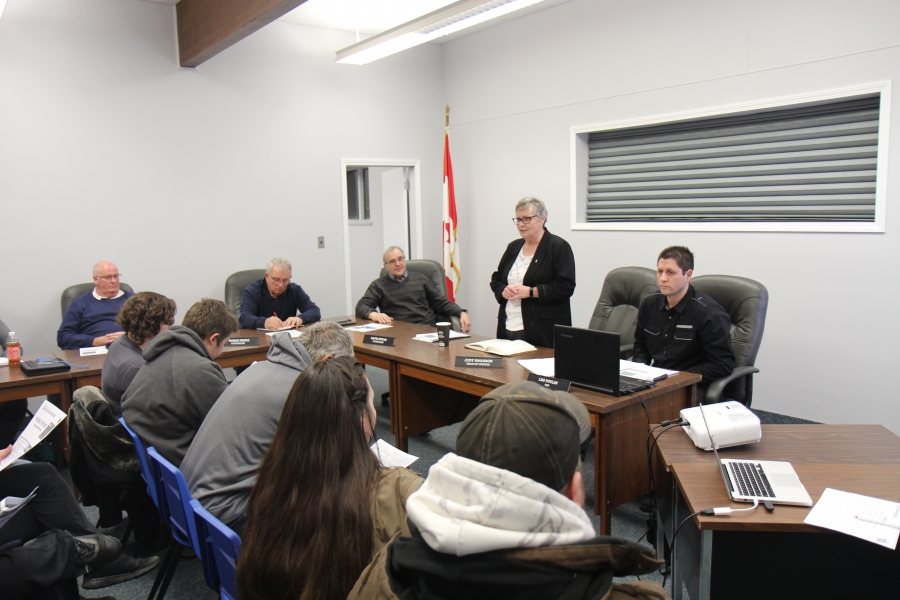
Head of Council Judy Swanson said she was happy to have a large crowd on a frigid night. The point of the get-together, she said, was to discuss the implications of the Municipal Amalgamations Act. At the time of the original merger, the Province allowed them to run separate mill rates for a period of time. However, this time is running out. According to the rules, a single mill rate is necessary no later than 2023.
“We are looking at different things we can do to make this work out,” Swanson said, “since by law we have to do this.”
The difficulties of a single mill rate are many. For one, property in the rural part of the municipality is worth much more, and is assessed higher. Meanwhile, there are fewer people there than in the urban part. The fear is, if one mill rate was used at large, a smaller population would be paying more for services they often do not use, while a larger population would pay less for more services.
“We’re continuing to lobby to keep the two mill rates. But if that is not possible, we want people to realize, there will be special levies put on your taxes that will balance out the urban and rural. This council is totally behind the idea of lobbying, but if we can’t we want to make sure it does not shift from urban to rural.”
Administrator Leo Poulin showed the public how one mill rate would impact the community and some of the possibilities to deal with it. Using the 2018 budget as an example, Poulin said if they went to one mill rate, the urban mill rate would decrease by 10.6%, while the rural would increase by 16.9% - a very significant change.
He said the two options they have to mitigate it are to create an LUD (local urban district) or to create special levies for specific services. The LUD’s are common in smaller communities like Ninga, working under a larger municipality and having their own committees. The problem with those, Poulin said, is that they add costs, create more meetings and political headaches.
If they were to have special services, the Municipal Act allows this for many different areas, like drainage construction, fire and police, collection of waste or recyclables, snow removal, and many others. To do so, they would have to analyze the situation. Then they would have to hold a public meeting on the proposed levy. After that, they would give first reading to a by-law then send it to the Municipal Board for approval. When that was finished, if the board gave approval with or without conditions, it would come back to council for passage.
Considerations they would be looking at would be the impact on rural versus urban properties as well as higher and lower assessed properties, number of properties in each class and the changes to the Education Property Tax Credit.
Proposals they are looking at are urban special services and recreation special services. The urban service would be an extension of By-law 88-03, which includes street lighting, fire and police. The new one would include transportation, beautification and animal control. It would be a combination of per parcel and assessment. Higher assessed residential properties would see a reduction, institutional properties (schools, churches, government etc.) would see an increase and commercial would see a decrease.
A recreation special service, it would be on all residential properties and based a combination of per parcel and assessment. Their total recreation cost in 2018 was $434,000. If it were based on per parcel alone, the cost would be $409 per property. If implemented all residential properties would increase taxes, while farmland and commercial would decrease.
Poulin added they are also dealing with changes to the Education Property Tax Credit as of this January. Now it will no longer offset municipal property tax and according to municipal figures, this will impact 334 households in Boissevain-Morton, mostly in the negative. Examples showed that an urban property assessed at $75,000, would see their taxes increase by $305.68, while one assessed at $100,000 would increase by $174.40. This is before any changes the municipality would bring forward regarding the mill rate.
In fact, all of it is quite complicated. The areas listed as special services do not include general government services. Under a single mill rate, rural people would pay more for council.
“This is very, very tricky,” Swanson said. “What we don’t want is to shift everything to the rural. We want it to be fair. This is not a simple, little thing. If we take everything and make a special levy, we have to have notices, meetings for every one of them, each time we do it. We have to send letters out to everyone involved.”
In essence, the idea is to keep the system, in dollars and cents, the same as it is now. In order to do that, there needs to be a lot of wiggling around and special levies. Swanson said in smaller, rural municipalities where everything is the same, one mill rate is not such an issue. In ones with urban-rural divides, it creates massive discrepancies.
There were questions about the need, from a Provincial perspective, for a single mill rate. Although they had talked to the government about it, Swanson and Councillor Rob Adams said they did not get a good answer. Many asked if it would be better to simply lobby the government to allow them to keep their two mill rate system?
This is what Boissevain-Morton Council is planning to do. Councillor Rhonda Coupland, who is on the Association of Manitoba Municipalities Board of Directors, said the AMM supports choice for municipalities on mill rates. The answer they received in return was that municipalities were given “lots of tools” to deal with the situation.
When asked for a show of hands by HOC Swanson if they wanted two mill rates to continue, the crowd voted close to unanimously to keep it the same. She said their plans were to keep working to do that, while trying to cover their bases.
“The two of us (urban and rural) work well together and we will continue to do so,” she said. “We didn’t want amalgamation, but we made it work. We will continue to lobby for two mill rates, but we can’t just wait until the deadline to change. So we will keep doing both.”
by PAUL RAYNER, Recorder staff