
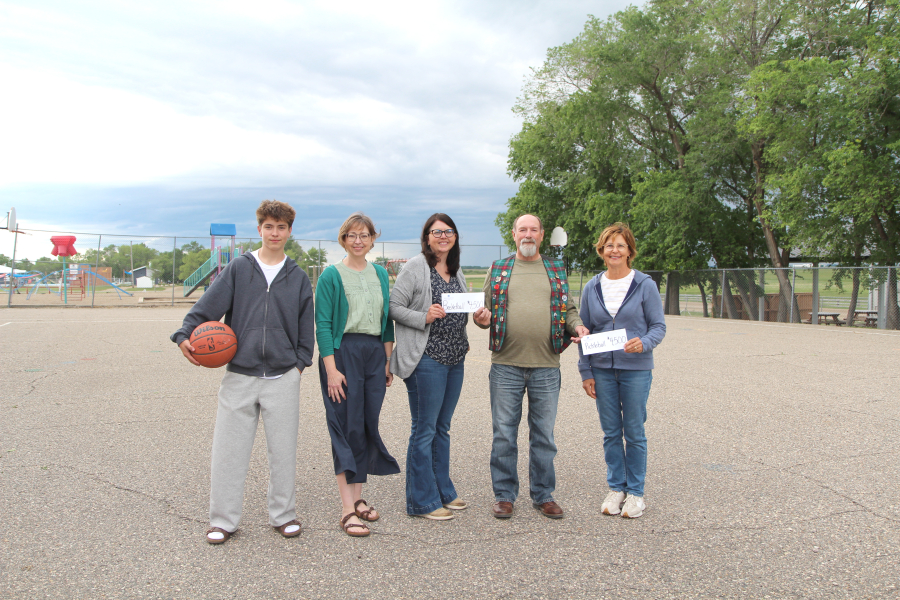
“In my opinion, play shouldn’t stop. A lot of things only focus on the younger kids, but we need to keep kids physically active, to build good habits, to exercise through life.”
To do this, they began looking at the old tennis courts. There had been the idea of developing a volleyball area, but due to how light a volleyball is and how windy Manitoba can get, this was dropped. Then, they moved to basketball.
“Basketball is a universal game,” Janssens explained. “You can shoot hoops by yourself, have a couple of people, or have a full game.”
The first step to develop this will be work on the concrete itself. The area has the inevitable cracks that come from age and our climate. Completely rebuilding the base would be extremely expensive, and there are no guarantees it would last very long. Instead, they are looking to fill the cracks. Janssens said JCI Brandon came out to look at the spot and will be filling them and putting on some sport court surfacing and liner. It will take maintenance over time to keep it in shape.
“It gives us an affordable option, which is reasonable for our community.”
The court will have a different shape, being wider than normal. With two hoops, it will allow for full use or the common half court games. This would allow two games at the same time. They will also be making the area accessible to all by having everything from the parking lot in on one level.
Janssens added they received money from the Boissevain & Morton Foundation to purchase a pair of bleachers, which could mean people could watch what is happening on the court. There will be a space between them so people with mobility issues can sit in the middle and be a part of the action.
The bleachers/basketball court will be on the east end. Moving westward, there will be two pickleball courts. Pickleball is a sport growing in popularity. Janssens said they were applying for a grant in the spring of 2025 when the idea of pickleball came up. They reached out to Wendy Giesbrecht at the Recreation Office to get some help with fundraising for that end. She said they found if they build those courts at the same time as the basketball, they could save $10,000. An email was sent out to the local pickleball community who were looking for a space. They joined forces and Janssens said the pickleball players under Elaine Vandoorne have had a lot of success raising money for their part of the space.
“There really was a lot of interest there. Pickleball is a growing sport.”
She added they were also looking at adding a smaller basketball spot farther west for younger kids. This has not yet been settled.
For the middle school space, the committee had sponsorships from the public and businesses at different levels. People are still donating that way, but there is a special one for the basketball courts, where people can purchase squares for $100. There are also bigger ones coming in, such as $4,500 from the Lions for the pickleball and $4,500 for the basketball court. They also received $5,000 from ADAMA Canada from their Stomping Grounds Community Initiative.
Janssens said the amount they were raising for this phase was around $90,000 and they should be at that level now.
The plans are to get to the practical work right away. They are looking to start in July, and if Mother Nature cooperates, they could be finished everything in about two weeks. That would mean people could be using it this summer, and it would be ready for the students when they come back to school in the fall.
“Our summers are so short,” Janssens said, “we want to be able to enjoy it right away.”
The success of the middle years playground was inspiring for them. As Janssens said, to start up in 2023 and have two phases done by the fall of 2026 is beyond impressive. Other communities have asked them for advice on how to get everything going so quickly. They are already looking at phase three, which is a revitalization of the primary playground on the east side. That will take a lot of work, so Janssens said they are looking for more people to come on board.
Overall, these spaces are located at the school, but are for the community as a whole. This is important, as community continues to be a key to making them work.
“When people ask how we were able to do all of this so quickly, my answer is our town. Our people, our businesses, they supported us from day one. The community was really locked in.”
by PAUL RAYNER, Recorder staff