
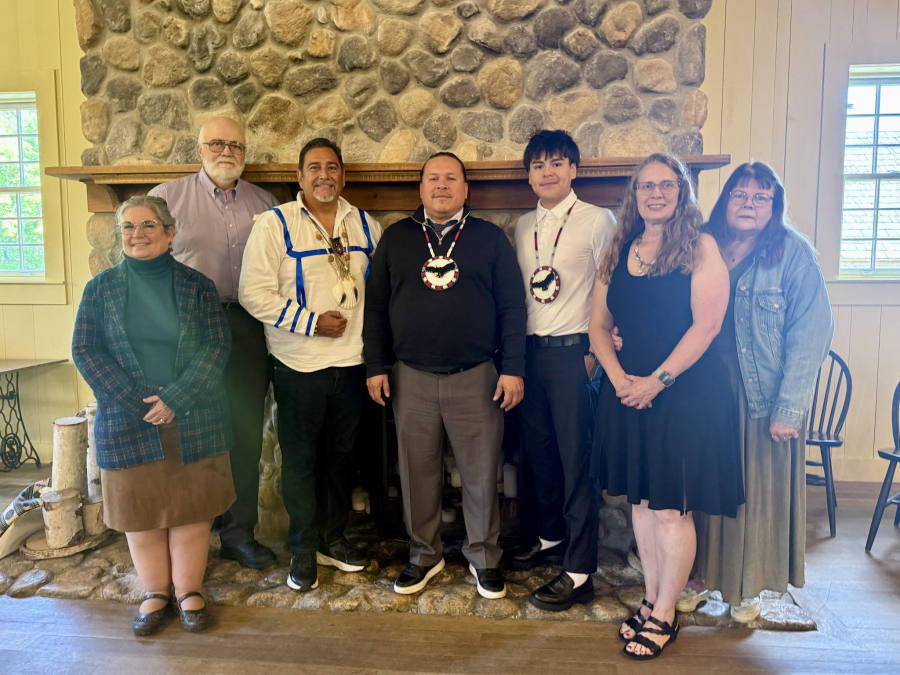
“The return (donation) of their artifacts came about as the result of trying to decide what to do with the artifacts after my sisters and I have passed on,” Dickson explained. “We know of other families where similar artifact collections have been lost. The artifacts were always stored in the farmhouse and theft was another consideration. I use the word ‘return’ because we are really returning lost property to descendants of the people who lost those artifacts.”
He said he heard the Southern Chiefs had taken over the old Hudson Bay building in downtown Winnipeg, with part of their redevelopment plan including a museum. Dickson talked to his sisters, and they all agreed this would be a good place to keep the collection, as it could be used for educational and enjoyment purposes by both First Nations people and other Manitobans. So he contacted them about three or four years ago, and started the process.
“They were thrilled with the idea. It has taken some time to make the final transfer arrangements as their plate was full of project work on the HBC project as well as the Princess Patricia former army base project.”
It also took time to work out a legal agreement and for the Southern Chiefs to find a government department to store the items until the museum was ready.
Dickson said his father and grandfather started collecting the items when they began farming. In fact, some might have been discovered by their great-grandfather Duncan Henderson when he first came to the area in 1882. They were found by regular farming operations, although there were also two not from the Boissevain area. He said tillage, particularly summer fallow, was a key to finding the artifacts.
Once the soil surface was black a summer rain would wash the earth off of an item, adding an arrowhead would reflect a glint of sunlight.
There was quite an array of different pieces collected. There are different sizes of arrowheads, spear points, hide scrapers, an axe head and others. Some are broken, whether by time or being hit by farming implements. Dickson said a friend from an Indigenous community saw two grinding stones and felt they were likely for grinding berries, similar to one his mother had. He added an expert would have to look at them to see which group of people they belonged to as the Dakota, Cree and Anishinaabe (Ojibwa) all moved through and lived in the area.
Dickson said his father had the pieces in a display cabinet at the farm, and though he did not show them off a great deal, fearing theft, the kids were familiar with them.
“All four of us children were quite well aware of both Earl Henderson’s and our parents’ interest in the Indigenous artifacts,” Dickson stated. “We can remember dad coming in from the field with a new arrowhead or hammer that he had found while tilling fields.”
As Dickson explained, the organization was thrilled to receive the artifacts. He was told Indigenous people have very few pieces from this time as settlers usually kept what they found. He noticed before, during and after the pipe ceremony everyone treated them with great respect. They were interested in everything about them, such as who found them and where. Knowledge Keeper Allen Sutherland was very taken with some of the items, and Youth Chief Billy Bird felt they would be very important to the young people, giving them a connection to their past.
It was a moving ceremony, and Dickson said the whole family was happy with their decision.
“Yes, we were all thrilled to be able to return them to such a warm welcome from the SCOINC,” Dickson said. “We never felt we owned the artifacts; we were just the caretakers of lost property but until recently we did not who to return the artifacts to. We are now feeling reassured that that the artifacts are in good hands for preservation for future generations to admire and enjoy and learn from.”
The family still owns the farmhouse near Whitewater, which they visit. A lot of history has been discovered there, and Glenn Dickson felt it was important to pass it on to the descendants of those who made it, for them to continue to learn from.
“We feel it is an important step in reconciliation to assist the Indigenous people to have that physical connection to their ancestors and history. It is also possible that some of these artifacts may have ended up in SW Manitoba from other regions of North America through indigenous trade routes. That would be up to professional archaeologists to determine.”
by PAUL RAYNER, Recorder staff