
“I think so,” Neufeld said, “Once we actually reviewed the final cut it looked good. You always think of things you could have done. I was quite intimately involved in writing it and I am a relentless editor. Our chair Jan McLelland is even more of a relentless editor.”
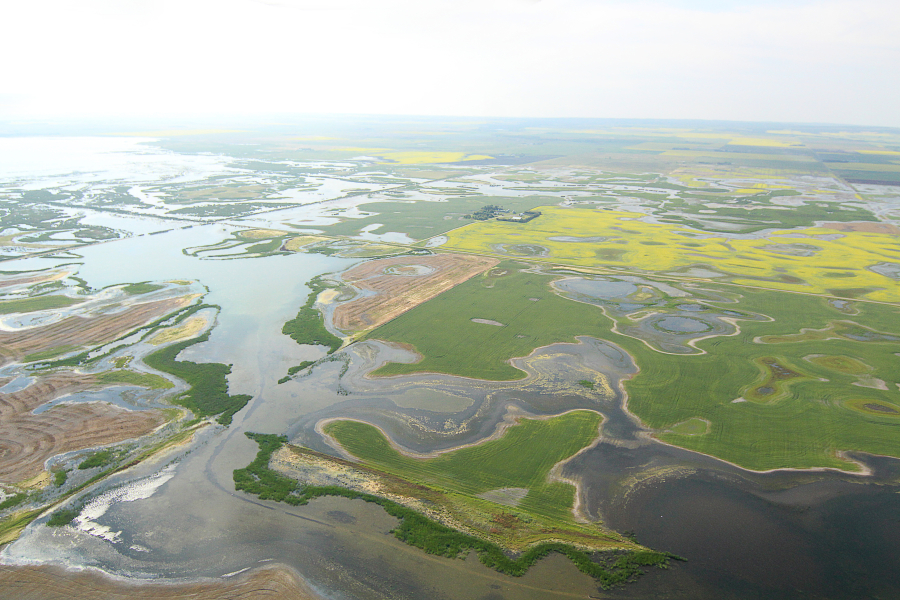
The film is a look at the lake located between Deloraine and Boissevain, a body of water that can either disappear or flood the area. The association had already written about Whitewater in the first volume of the Vantage Points history books. Neufeld said originally he was thinking of a film for younger people, a way to interest school children in local history. As time went on, he said, they realized the many challenges of the lake meant a less folksy, more serious film was warranted.
The lake’s history includes bison grazing by Assiniboine and Metis people, and has been long a home for many waterfowl. It is known as a “terminal lake”, in that it has little or no natural outflow.
This means during wet years, it will rise over its banks as the water comes down from the north side of the Turtle Mountains. It can also dry up, as it did during the 1930’s and 1980’s. Farming in the area increased the impact of these cycles, to the point that after the flooding of 2006 and 2011, municipalities in the area tried to find a way to regulate levels.
For this film, Graham Street and Shaun Cameron of Street Media were chosen to do the filming. Street himself is no stranger to the area, having worked with local Marc George on the Warpath series examining Boissevain veterans of World War One. He said they had previously worked on a TMSPHA film about Chain Lakes, and were contacted by them to get involved again.
“Right away, we wanted to work with the association,” Street explained. “We worked with them in the past and knew it was a good fit.”
Street said the film was a year in the making, with the shooting starting in the fall of 2023. One of the keys was to tell the story of Whitewater and Turtle Mountain over four seasons. Talking to different people during the different seasons, they were able to look at the diversity of the lake from all angles.
Cameron said it was a story that grabbed them.
“It was a really unique opportunity to tell a story,” Cameron said. “It has a unique history in the region, which attracted both Graham and I.”
Street said the TMSPHA was very helpful in setting them up with places to film and people to speak to. Neufeld said he travelled with them to help them get what they needed.
Many different perspectives appear on the film. The late Tom Moran presents a conservation view, while Brad Bird represents the trappers. Boissevain-Morton Councillor Rob Adams speaks on the municipal challenges of a swelling lake, while area farmers are also spoken to. Neufeld said they wanted to grab the perspectives of all people who were impacted by and invested in the lake.
Street said they hit the ground running in 2023 and began working on a film that would tell the history of the area in an easily digestible way, with stories and narrative.
“We talked to the people in place,” he stated, “the people on the ground with their stories. Also, we were very much interested in the whole watershed, how it all worked together.”
“It is a little bit of everything,” Cameron added. “A bit of history, how people interacted with the lake then and now, and the lake itself. There were times it dried up, and also flooded. It is a story of the diversity of the lake and the relatively symbiotic relationship.”
The film is 25 minutes long. As well as the story of the lake, Neufeld said they also wanted to focus on the natural beauty of the site, one his “adventure group” is quite familiar with due to many activity visits.
“The sunset over the lake is magic,” he explained. “We have kayaked and biked in the area. The islands there have white sand. It is an amazing place. They used drones to take film and it is really nice. It does the lake proud.”
The story is actually told from the perspective of the lake, with Christina Guenther serving as the lake character.
Tuesday, October 29 is the first showing at Boissevain Theatre, with the group moving it on to the Evans Theatre in Brandon (November 3), Deloraine (November 5) Elgin (November 7) and Melita (November 10). They will also be showing their previous two films Precious Load and the Chain Lakes Barn. Both of these were released during COVID and so did not get wide viewing and it makes for a more worthwhile evening for those coming out. They are hoping for donations to help with promotion of the films.
Cameron and Street are presently working with Gordon Goldsborough of the Manitoba Historical Society on different projects including Manitoba Heritage Minutes, which gives a good, short look at happenings over the years in the province. They can be found on YouTube. Both feel the Whitewater Lake story was worth telling. Cameron said when you make a film, you often forget people will be watching it, so they would both like to make the premiere to see the reaction of the people to their story.
“We always like to work with anyone who wants to tell stories,” Cameron said. “In lots of ways, it’s like a time capsule.”
“I think it’s important,” Street continued. “Often you look at the grand narrative, but this you take to the local level, how things shape the province we live in. We like to tell stories this way.”
Neufeld is hoping for a good turnout for the showings. It is a part of an effort to give people a reason to take pride in their surroundings, and even if they travel afar, realize they can come back to their home area as a great place to live.
“We have very unique features here,” he stated. “We want kids to appreciate that. This is teachable history.”
by PAUL RAYNER, Recorder staff