
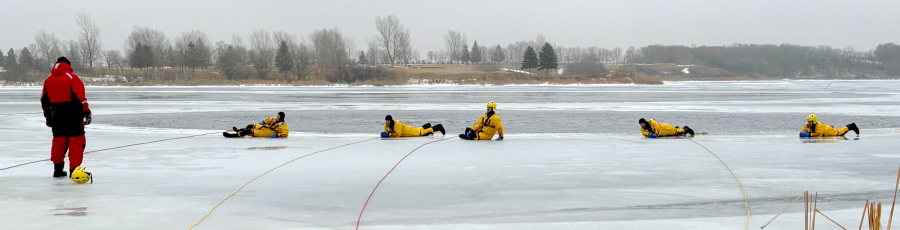
She added the two departments work together in Mutual Aid and do training together at times as well. Brandt VanCauwenberghe, Tyson Lehman, Brennan Mann, Chris Manshreck, Kent Corkish, Mark Kliever, Rylan Rommelaere and Brendin Hammond participated from the Deloraine Fire Department.
Mustard has served a couple of terms with the Boissevain force. She started in October 2002 and continued until June of 2007. She stepped away as her kids were young, but re-joined in 2021.
Trans-Care Rescue was started by Bill McCombs in 1981 as a training company. They have their own facility in Saskatchewan, and also do on the road training courses in areas like confined space entry, embankment rescue and ice water rescue. As Mustard said, the instructor brought out all of the equipment they used for the course, which was 10 hours in the classroom and six out on the ice/water.
She said in the classroom they went over the fundamentals of ice rescue, including learning about dealing with hypothermia. This situation, in which the body loses heat faster than it can be produced, can be very dangerous and is common when a person is exposed to extreme cold, like when they are in freezing water. As Mustard explained, people who are hypothermic can be quite fragile and go into cardiac arrest easily if not handled gently.
They also went over different ice rescue situations, from person to person to using minimal equipment to bigger pieces like the floatation device, or “banana boat.”
“We just went over a number of different available scenarios of rescuing a person, giving them what we have available on scene. We looked at different ice situations, the different types of ice, the quality of ice, what would be stronger and different situations like that.”
Once outside, they donned the winter rescue suits. Although the pictures make it look very cold, Mustard said the suits keep the department members quite warm, which was recognized by Deloraine Fire Chief Jerry Redden. They do need to get used to the feel of the suits and working in them, as they can be clumsy and a bit awkward. Once that was done, they worked on scenarios.
The first one was a person holding on to the edge of the ice. The trainee had to go over and get them out on their own, either with a sling or getting in the water with them. They also worked on the same scenario with the floatation device, pulling them up on it.
As well, the instructor had them work from the standpoint of a patient being unconscious or too injured to help with their own rescue.
They worked in teams with different numbers of people involved in different ways.
Although Trans-Care did not bring out the airboat, there were ropes, a backboard and the yellow floatation device to work with.
“All of the hands on equipment you can use to help get someone out of the water,” she said.
They also discussed coordination with the EMS people. Paramedics have the ability to deal with issues like hypothermia. The hope is the paramedics can attend the scene immediately, but sometimes they cannot get to the exact spot so rescuers need to be able to deal with situations too.
Mustard said she enjoyed the training, saying it is not fun to use the skills in a real life situation, but in the controlled atmosphere of training, it can be.
“It can be an enjoyable experience,” she stated. “I wouldn’t say there would be any nerves involved, because you’re dealing with professionals in a controlled environment, so I had no concern for safety or anything like that. Being in the water was actually very relaxing, getting in those suits and being in the water. It was easy to get in and out doing different scenarios. It wasn’t stressful or straining at all.”
In the local area, with cold winters and a lot of lakes, this training could come in handy. Mustard said there could be issues from ice fishing to skiing to kids being out on thin ice that could make the training useful. Redden said they have been looking to do this kind of training for a while.
“There’s lots of water in the country and we need to be prepared,” Redden explained. “It was good to get the training and all the participants would highly recommend it to other departments.”
The Boissevain department does not have the winter suits or equipment at present, but now there are a couple of members trained, it could be a part of a future wish list. Redden said Deloraine is looking at four suits, at a price tag of $12,000.
The fire departments continually train as well as go out on calls. As well as the regular times – Boissevain practices on the first and third Monday – they also attend courses like the recent one. There is no pattern, Mustard said, as it is based on what is available and who can go at the time. All of the training is valuable.
“Very much so. We hope to never come across a situation like that, but if and when we do, we will have a lot more skills to approach the situation more quickly and efficiently and help the patient. When you have it taught and organized by a professional, it puts it together in a nice package.”
by PAUL RAYNER, Recorder staff