
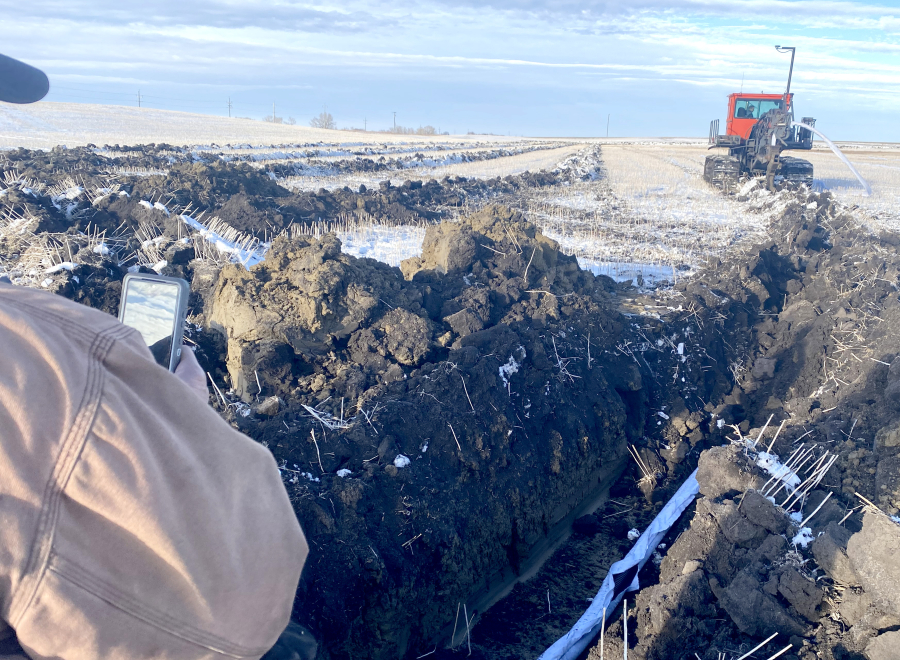
“It allows you to get on the fields earlier in the spring. You are not completely at the mercy of Mother Nature. You can actually plan on your farm.”
By the same token, they work to make sure it only takes away excess moisture. That way the tiling does not impact a field during a dry year. Tiling just brings the land to capacity, without it going over. In some cases, farmers have collected water from the tiles to save for times when it is not so plentiful.
It has been known to increase crop yields as plants can receive the right amount of oxygen, and allows for the plants to seek deeper moisture, therefore improving the roots. It can create better nitrogen use efficiency.
Also, tiling can have a positive impact on the salinity of the soil. Some soil has a higher saline table in the water, which can create alkali spots, rendering the land unproductive. By removing the salty water, and creating a better ground situation, this can reduce or eliminate the problem.
Mealy said they could do any size of field, it would just mean using more or less piping. The big thing is adjusting for a hilly or flat area.
“If it is flat land, we would usually do a full quarter or half,” Mealy stated. “We can really do any amount of acres.”
Mealy said they have been working with K & S Tiling of Gretna, adding he was working with them full time this year to learn the process. It worked well for them, allowing them to get an idea of the business before fully striking out on their own this year.
Mealy said they do the planning with the GPS to set up where the pipes and other equipment will go before the digging starts. Typically it takes five to seven days to install the tiling system. What often takes longer is the licensing process, as it goes through the municipality then the Water Stewardship.
Impact worked on their first major project this year. At Scott Day’s property west of Dand, they put tiling at 20-foot intervals where the salinity is at its worst, then 40 foot intervals for the rest of the field. The hope is it will reduce the salinity or at least keep it from encroaching further.
In the Boissevain area, the farm of Wes and Ian Froese north of town is in the process of a major tiling project. Much of the nearly 300 acres they will be tiling is already done. Ian Froese said the decision to go in this direction is a part of making the area better.
“Our goal is always to improve the land,” Froese explained. “Tile drainage will improve our drainage and the land itself. The land we have is close to Whitewater Lake, flat and poorly drained. Some of the soil is not good for plant growth and has higher salinity.”
In their case, their system is based on releasing water into local Cherry Creek. The idea is they have to pull as much water from the area as they release, just during different seasons. They will have a couple of retaining ponds for this purpose and they can measure the amounts they take in and discharge the same amount in the summer. Froese said there is always the possibility of using the water collected from tiles on the land, but they are not sure the discharge is good for farming.
Precision Land Solutions from Winkler is doing the work, with Flukers of Boissevain building the reservoir cells. The work was stopped in December as the ground froze, and Froese said they hope to be completed in the spring.
Mealy said they still need to buy some equipment for their business, which they are working on this winter, and hope to be fully up and running by this summer. He added this is a business with a lot of potential.
“More people are doing this,” Mealy stated. “With land prices being higher, it makes more sense to improve the land. It has become more attractive.”
Froese said they will see how the initial project on their farm goes, and see if they will continue with more acres.
“Anytime I talk to someone, they say once you start tiling, you do not want to stop.”
by PAUL RAYNER, Recorder staff