
Then in 2005 I moved to Melita to help create MAFRI’s new applied ag research program under the name of WADO. In 2011 (after that summer of nonstop rain) I answered the call from a farmer friend in Iowa to help create a new type of agricultural investment firm that would be based in San Francisco. So, Ann, Alex and I headed to the Bay Area for that winter to create this new company with three others (we had all met the year before at the friend’s wedding).
This adventure turned out to be a new career, yet I continue to farm at Dand with my family to this very day and Ann and I still live in Deloraine each summer, but we live in San Mateo, California each winter, where our head office is located. I continue to work for our company called “Fall Line Capital” even when we live in Deloraine in the summer, using Minot for flights or driving to our farms in the Northern US.
Fall Line invests in farmland across the USA, seeking undervalued farms that can benefit from our abilities in development and management. We generally focus on “row” crop farms, which in the USA means crops like corn, soybeans, wheat, potatoes, but not permanent crops. I have even had to learn a little bit about cotton and rice.
We work with local farmers to operate these properties, but our underlying thesis in the management of all our farms is soil conservation, as we want the main asset of our farms, its topsoil, to remain in place or even improve over the period of our ownership.
We are not a public company; we are a private investment firm and most of our resources come from Endowment Funds. At this point we work with about 60 farmers in four regions across the USA. I think many of you would really enjoy this opportunity, as I do, to travel throughout America looking at farms and imagining ways to help those farms operate at a higher level. It has also provided me an incredibly unique vantage point to observe rural America, especially over the past few years. We are a small team with the four original members and then nine others in the office and in the field, and we also come from six different countries.
One important aspect that makes our company totally unique is that we also invest in New Agricultural Technologies. This has grown to become a significant part of what we do, and it is garnering much more of my attention as well. The fact we are based at the north end of Silicon Valley has allowed us to see firsthand much of the latest ag technology while it is still in its infancy.
For instance, I met the geniuses at BlueRiver back when they were just in a room in a strip mall in Silicon Valley. In that small room there were a few Sony cameras and a bus shelter advertising scroller with pictures of weeds on the canvas, turning over and over to build their “algorithms” (the most overused word in Silicon Valley) to spot weeds in growing crops. They sold to John Deere a few years later for $300 million, and their high-speed optical differential technology will soon be common on many types of new farm equipment.
We are currently looking at some incredible leaps forward in farming technology. We have visited with companies that apparently have figured out the incredibly challenging quest to make N fertilizer without a carbon-based energy source. I am not talking about the small Haber-Bosch systems that can now use electricity instead of natural gas, but rather new N making processes altogether that may allow you to make N on your own farm in a way that essentially eliminates GHG emissions and still be cost competitive to what we can buy now.
There is also new technology that could allow us to use 3/4’s less P fertilizer without any impact on crop yields.
There are several companies that are developing new crop pesticide products from designer proteins. They are simply creating proteins that have the shapes and characteristics that mimic synthetic chemistries, so they can attach to the same “receptor” sites in pests that conventional pesticides use and therefore cause the same expected outcome (death to only the pest). This is an exciting new field of science, where “natural” and highly specific pesticides are being created that are extremely effective but have no impact on any other living thing besides the target. These new pesticides are entirely proteins, so they quickly degrade to simple Nitrogen, there are no residues or restrictions to be concerned about. It is as if we made weapons or tools out of ice that quickly melt into only water when we were done using them.
One of our most exciting ag tech investments at this time is in a company called Greenlight Bio - they are creating mRNA based crop protection products for pests like insects and diseases and should soon have their first commercial launch with a Colorado Potato Beetle insecticide that works amazingly well, for reasonable value, and has no effect on any other insects. You might recognize that RNA technology. It is also being used to create some of the new vaccines to combat COVID-19. Ultimately many new crop protection products could be considered “organic” in the foreseeable future yet be even safer than some of the organic pesticides used now.
Fall Line has currently invested in 20 new Ag Tech start-ups and at this point they are all still alive, which, I have been told, is an exceptional record in the world of tech start-ups. I think our truly diverse background with some of us still being farmers, allows us to evaluate and understand new ag tech ideas from a unique and effective perspective.
We have an investment in AgroFy – which is an online marketplace for Agriculture currently based in South America but is poised to expand to other regions, it is like the Amazon for Agriculture in the Amazon :)
We recently invested in VergeAg, a Calgary based company that directs peak efficiency usage of farm equipment (check their website).
We have invested in a company called Ethernovia that is creating a whole new protocol for very high-speed wireless communication of all the sensors in cars, trucks, and equipment. This will allow your sprayer, planter or combine to properly process all those billions of HD images and other inputs they will be collecting on the fly and then adjust your implement accordingly as it goes across your field at full speed (without wires).
We have invested in a company called Swift Navigation that has built RTK guidance systems that cost a small fraction of what is available today. They are doing well as the autonomous explosion needs RTK.
We have invested recently in an Israeli company called UKKO that has created a new type of plant gluten called “safe gluten” that prevents any sort of gluten sensitivity problem in humans, including being completely safe to people suffering from Celiac disease. It is still gluten and it still allows the flour to do all those wonderful things that we love gluten for in the first place, but it does not have any allergenic consequences. They are also developing peanuts that are allergen free and a therapeutic that will cure people from their peanut allergy in the first place.
We have investments in Impossible Foods and Ripple Foods, companies that are creating plant-based protein foods. Plutoshift uses AI to identify and create energy efficiencies in fluid management systems (irrigation systems, food processing, and municipal waste systems). We have investments in two of the top drone spraying start-ups: Rantizo and Kiwi.
SoundAg was one of our early ag tech investments and their amazing team of scientists have recently come up with a totally new plant breeding platform that is a modified epigenetics system. It is not a GMO or CRISPR crop breeding system, yet it can achieve similar results in much less time. Certain genes can do very specific things even when it is just the amount of expression of that gene that is adjusted. With those older breeding systems, it was usually just an on/off switch for a specific gene. This new type of epigenetic platform will allow an incredible number of traits to be easily improved such as: taste, protein levels, plant structure, virtually everything that is controlled with the existing genome of the plant can be fine tuned with this platform. However, here is the amazing part: these changes will be simply created with a specific, custom made “solution” that will be applied to your seed prior to planting – just like a regular seed treatment! This will “methylate” the DNA in accordance with the trait needs and presto! Your crop will then have that trait you desire: maybe higher protein? Or shorter stature? Or better pod shatter resistance? The seeds from that crop will carry those traits to the next generations and/or you could treat your seed the next year with a different seed treatment solution and have different traits that add value in that year. Essentially, this process can create a new crop variety in about two weeks. This is one tenth of the time needed to create a new variety by using CRISPR, which itself needs only a small fraction of the time compared to that needed to create a new variety using conventional breeding programs, which would often take up to three years or more.
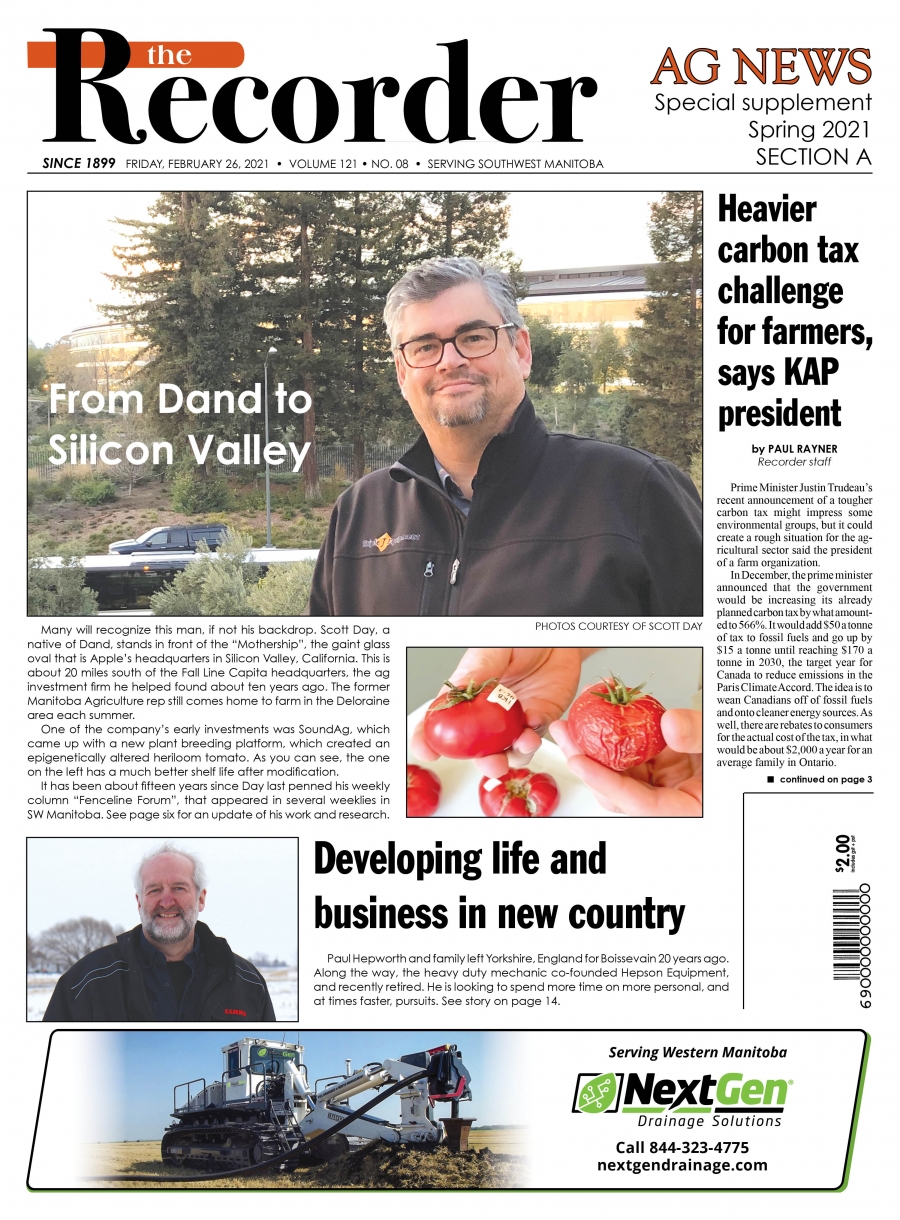
SoundAg’s first success with this system was a new epigenetically improved heirloom tomato that they quickly created a few months ago. They were trying to create an heirloom that looked more consistent and had a much longer shelf life, but still looked like an heirloom tomato, and as you can see from the photo they succeeded. I expect they will achieve similar success with the many other crops they are working on right now.
Considering all I have shared; it will be exceptional if most of these new ag tech ideas are successful or even make it to market but I sure some of them will. I am simply sharing the promise and potential they all possess at this time.
If you can remember, you will notice this column is a little different from my old Fenceline Forums in the past – where I offered to test all your Christmas baking before gifting, or how I got rickets from killing my mom’s garden with an herbicide experiment gone wrong. Hopefully, I have progressed a little, but I have always enjoyed and appreciated sharing what I knew in the field of agriculture over these past 32 years. Hopefully, we can be enjoying some of these new technologies on our SW Manitoba farms in the not-too-distant future? BTW I am still willing to test everyone’s baking, and I still run funny.
by Scott Day, Directory of Agronomy, Fall Line Capital