
“We love our volunteers,” stressed Judy Swanson, Head of Council for Boissevain-Morton, “and we are very thankful for our volunteers. In this time of COVID-19, we had to make some changes.”
For one, the volunteers, who created our recycling project and had made it into the envy of many communities, as well as a major part of Boissevain’s Communities in Bloom efforts, were given the stand down. The most obvious reason was they are seniors and seniors are in the most vulnerable category for COVID-19.
“It was difficult, but the people with potentially the highest risk were the same people who were doing the work.”
Clayton Fisher, the coordinator for the volunteer effort said there were around 16-18 of them going to sort twice a week for a couple hours or so. The restrictions kept people over 60 out of the plant, which meant most of their volunteers did not qualify. Right now, Fisher himself is doing the paperwork, which is considerable.
“There is ordering the parts, keeping up with the prices of baled material, ordering trucks in for getting it out,” Fisher stated.
Right now, municipal employees are involved in the plant effort, with Swanson saying they had some volunteers on hand early to teach them how to use the equipment and do the job. She feels there is some value to that at any rate.
“It is an opportunity to familiarize employees with the operation,” Swanson explained. “It gives them meaningful work to do.”
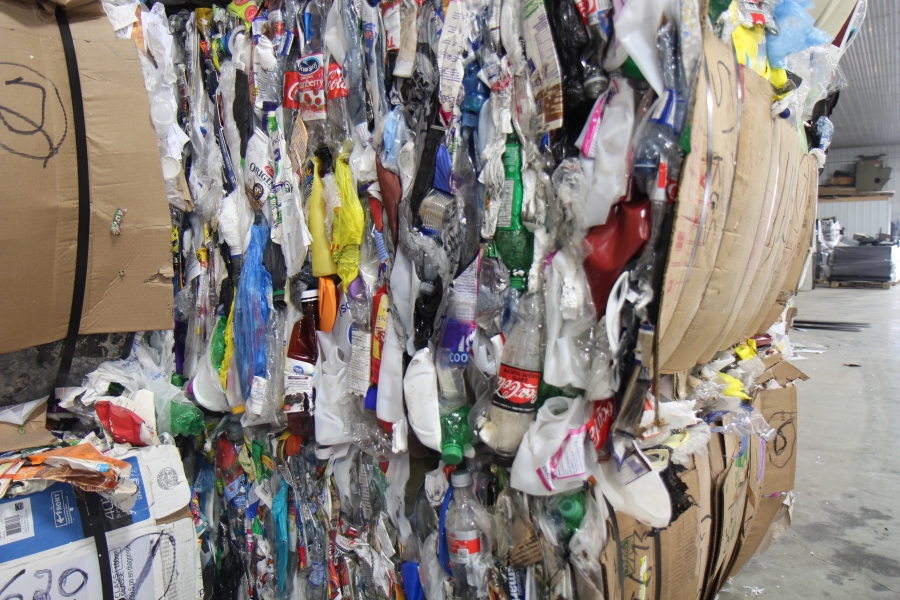
A major change is the recyclables are no longer being sorted. As Fisher explained, the volunteers would take what was gathered or dropped off, and sort them into different categories like metals, glass, different plastics etc. With a few exceptions like corrugated cardboard and e-waste, this is not happening. Instead, everything is simply being baled into big shipments.
Swanson said there are two reasons for this. For one, it keeps workers from touching the recyclables, which helps keep virus infection possibilities to a minimum. Also, sorting is too time consuming without the volunteers.
“If you are sorting it, you are handling it. Usually, the volunteers are at the big tables, sorting into big areas, purposely touching it. We just aren’t doing that now.”
Swanson added most municipalities co-mingle their recycling.
Fisher said this has its drawbacks. Although they are still able to sell the corrugated cardboard and some paper, the co-mingling means they cannot sell other products. In fact, they have to pay freight to have it taken away, and often pay the companies to take it. It is a double financial hit.
Swanson admitted it cost the municipality more to do it this way. However, as both Fisher and Swanson said, Manitoba Stewardship still pays for the overall tonnage of recyclables through the plant. It changes at times, but Fisher said it ranges from $30-45,000 per annum.
He added he recently got a call from recycling in Portage which they worked with a lot, saying that the price of corrugated cardboard was up if they had any to ship. They sent a truckload out. Fisher said he was surprised the companies were still operating.
Last year, recycling in Boissevain-Morton sent out 520 tonnes of material, up in some areas, down in some like e-waste. The hope is this total will continue. The blue boxes are still up; there is still curbside pick up of recyclables. The head of council stresses they still want citizens to recycle, which helps keep items out of the landfill site.
As for when recycling can go back to normal, Swanson said they are not sure what will happen. Right now, they need to get through the COVID-19 situation. They are listening to the recommendations of the province, and are cautious. She feels they will not see an early start but there will be ongoing discussions.
“This is the way we will do it now,” she stated. “We look forward to sitting down with the volunteers and talking about this. If sorting in the future works, that’s what we will do. We won’t make any decisions without talking to them.”
Fisher said some volunteers were reluctant to stop coming out and contributing to their community the way they had for years. He is sure many would love to come back.
“It is something to get up in the morning and look forward to,” Fisher said. “I would go back and help out if council decides they want to get the volunteers back.”
by PAUL RAYNER, Recorder staff