

“This might connect people in the rural areas to what people in the city libraries experience. It’s got Alec Baldwin in it, Christian Slater. We hope to get a reasonable number of people out to it.”
The $10 ticket price will go towards renting the theatre.
On Friday afternoon, June 14, the library will be hosting free coffee and cake from 2 – 4pm.
The library in Boissevain had its beginning with the Women’s Institute, who started a Rest Room in town, which had its own library. Over time, the community’s population increased, and there was a need for something bigger. The WI played a role in getting the new facility together, and after a by-law was passed, the new Boissevain-Morton Regional Library was opened on September 1, 1959. It was located in what is now Kilmury Tax on South Railway Street. The first head librarian was Bernice Pettypiece. Interestingly, over the 60 years, only three other people have held that role – Anna Grace Diehl, Phyllis Hallett and Michelle Scott.
Scott, who has been in the role since 1999, said there have been many changes in the library over the years, including the 20 she has been there. Although automation and replacing references like the card catalogue had begun prior to her time, when she came they were still using the Stacks software that Mike Diehl had created. Since, they have gone to the online system, which changed the scope of the library for its patrons.
“With the stuff we have now, you can check what you have at home, you can look at the card catalogue at home, you can sign out electronic materials from your mobile devices. That is the big thing.”
E-books have developed over time in all areas, and were obviously not part of the library in the ‘50’s and ‘60’s. Scott says they grow all the time as people get more used to them, but it is mostly for the convenience factor. If you are travelling, you can put a few books on your device instead of hauling hard copies around. However, there are downsides. She said if you put a hold on an electronic title to borrow it, the newer physical books would be in your hands faster.
Like everything else, prices have gone up. When she started, many of the newer large print hardcovers were in the low $30 range. Now, they are in the $50-60 range. It means Scott has to be more selective in what she purchases for large print novels. This has led to a lot more borrowing of books from library to library across the province. Once it is six months old, she can generally get it. However, that means the postage costs for the library have gone up about double since she started, around $1,000 a year.
Movie rentals became a big part of the library for a few years, with DVD’s going out regularly. Over time, with the growth of Netflix, YouTube and other entertainments it dropped somewhat.
The wireless is still well used, and a lot of people no longer have printers, so they come in to have their printing done.
Scott said the library is still well used. One interesting area for growth are puzzles. People love putting together these cardboard challenges, if they have the space to accommodate them. She said they have been fortunate to have many donated, as the cost of them might be why they are so popular.
“The thing is, they’re expensive,” Scott explained. “You buy them, you do them once, do you really want to do them again? People have realized they can come borrow them, do them and return them.”
As they range from 20 pieces to a thousand, there are plenty to choose from for all levels of puzzlers.
Storytime continues, with kids coming in the 15-20 number range for the morning program. They no longer have a summer program but still occasionally hold kids’ programs on evenings and other times.
There have long been discussions about how technology will impact the library. For many years, some felt the Internet and other developments would see usage of the building wane and books would just gather dust on the shelves. This has not come to pass. According to annual reports, the circulation numbers for all materials, including books, puzzles, videos, etc., have remained fairly steady. In 2016, they totaled, 28,097. Going up a little to 28,608 the next year. In 2018, they continue to climb to 30,062. Some of this is due to a growth in e-books, almost 6,000 last year, but nonetheless the numbers are still very good.
“We’ve stayed pretty solid with our circulation. We hear from a lot of people that they still prefer to hold a physical book.”
In fact, as of the most recent numbers, the library’s total circulation since opening in 1959 is 1,717,198 items.
Although the 60th anniversary is a time of celebration, there is some sadness. Longtime head librarian Anna Grace Diehl passed away recently. Her time in the library will not be forgotten.
“We were kind of looking forward to having Anna Grace a part of it,” Scott said.
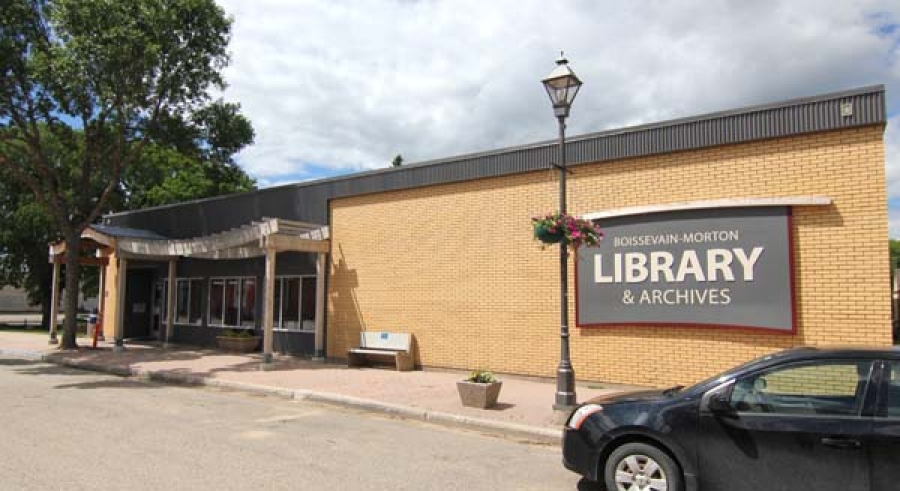
A happier change in recent years was the moving of the library from the old site to the newer one in the former bakery/Fields building further west and on the other side of South Railway in 2015. Scott said it was a major improvement.
“It’s been fantastic. We’ve had some water issues, but it has been so much easier without the stairs to get books in and out, people in and out. We’ve had so many more people with mobility issues be able to use the building.”
As for staff, Scott is joined by Leona Peters, Connie Dyck, Brad Peters, Jenna Crowe and Leigh-Ann Reichert for different levels of hours. Of course, the longest serving staff member continues to be Lucy Cassells, who has worked with nearly everyone in library history.
Right now, they are working on updating the Community Archives with the help of former board member Carole Kentner, getting a lot of items digitalized. Changes will always continue, but the library still has a good position in the community.
“I think it will stay pretty constant,” Scott stated. “The anniversary is one of those markers. We need to celebrate it being in the community this long.”
by PAUL RAYNER, Recorder staff