
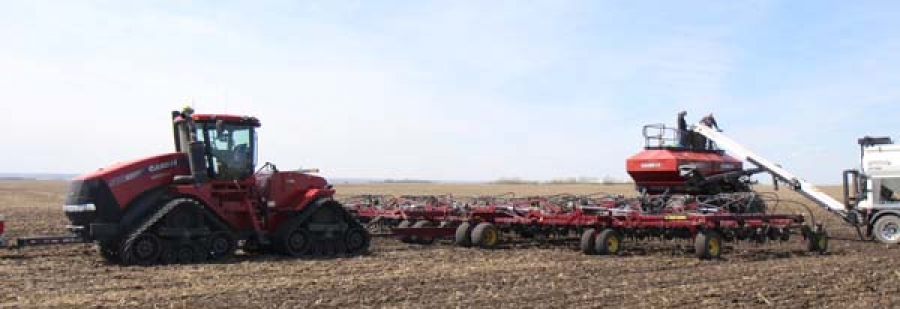
“Everything has gone smoothly so far,” Froese said this past week. “The dry conditions have allowed us to keep going. On our farm, we’re about 85% done. Most of the people around where we are should be done this week.”
It has been admittedly cool this year. Froese said crops that have been in for a while are slow coming up. He said barley and wheat that have been in the ground for three weeks are just starting to peek through.
One of the growing crops in the last few years has been soybeans. The pulses usually start going in the soil about now, as they need warmer ground. Surprisingly enough, Froese said they are starting to put them in, as the ground is warmer that one would expect. However, he added there are fewer acres going in to beans than in the past, saying they are only getting 75-85% of the seed orders.
“It just reflects the last two years’ yields and the price uncertainty. The last couple of years, there was a lack of rain. We haven’t had the August rains that the beans need.”
Froese said they have seen a fair bit of wheat go in this year, although certified seed sales are down a little. He said every one had gorgeous wheat crops last year, and are using their own seed.
He said he was surprised by the amount of oats going in. Prices look good for it and yields are usually solid. Also, feed and malt barley are also seeing a lot of action this year. Corn is becoming more popular as well.
“Anyone who is planting corn is putting more in, and others are getting their feet wet. Pricing is good, good revenue per acre. It also spreads harvest out a bit, as it comes up in October.”
The king crop for many years has been canola. However, there is a shock in 2019. Canada’s big canola market has traditionally been China, who could take pretty well as much of the oil seed as the country could send. In 2018, about 40% of Canada’s total canola exports went to China, worth about $2.7 billion. As well, there was about $1 billion worth of canola oil and $500 million of canola meal sold to the People’s Republic last year, according to the CBC. Now, the Chinese have stopped taking the Canadian crop. They say it is because of problems with the canola, but most speculation is the decision is being made for political reasons, as Canada arrested Meng Wangzhou, the head of Huawei.
Regardless of the reason, the move will hurt Canadian farmers. Froese said you could tell the impact on the markets.
“Most of the effect you see on the price drop,” he explained. “It was $11 a bushel two or three months ago, and now it is down to $9 - $9.50 a bushel. With lower prices, now it depends on yields to make any money. If we have any kind of tougher year, it will hurt.”
He said they will be sticking to their regular crop rotation, and figures most farmers will be doing the same. Froese said he expects there will be two ways of trying to deal with the situation – finding new markets and just hoping the problem can be solved at a different level.
“Sure, you can try to find new markets, but China is huge. They use a crazy amount of canola. They’re not buying ours right now, but we’ll try to wait it out. Everything is a crapshoot this year.”
One pleasant surprise Froese has found during seeding is there is some moisture in the ground. He is not sure where it comes from, but he is happy it is there. Drier conditions have made seeding move more quickly, but some water from the sky would be quite welcome now. The end of the week was to see 5-10 mms, with an additional five on Saturday. However, there was supposed to be some on Wednesday as well, and the POP for Friday dropped from 100% to 90%, so everyone will have to wait and see.
“We can definitely use it,” Froese said. “An inch or two would make me happy.”
As well, warmer temps, about 20 degrees, help crops move.
At any rate, soybeans and canola are going in, and farmers are beginning to finish up. Froese said he expects everything to move forward.
“I think things will start taking off now.”
by PAUL RAYNER, Recorder staff