
This is combined with very little precipitation. Almost nothing came until June, when the area had a couple of dumps – including a major hailstorm in the Minto-Margaret area, as well as other parts of the province. Since July 1, it has been dry as a bone.
According to the Manitoba Ag Weather Program and Environment and Climate Change Canada, from May 1 to August 12, 2018, the Boissevain area has received less than 160 milimetres of rain. This translates to about six inches. Reports are lower in Boissevain itself, which is around five inches.
When looking at Farmzone, part of the Weather Network, the normals for the Boissevain-Deloraine-Melita area in each month are considerably higher. In May, there is normally 52 mms (2.1 inches), June 78 mms (3.1 inches), July 80 mms (3.2 inches) and August 71 mms (2.8 inches). Half way through August we would normally have 245 mms or nearly ten inches of rainfall. The dry weather prompted the Boissevain Morton Fire Department to place another fire ban on the area.
Adding to the strangeness of the summer is the smoke. This is the year of the forest fire, as they rage from California, to Ontario, to Greece. However, Alberta and British Columbia blazes are the ones causing us problems. The week of August 6-10 was particularly bad with a smoky haze turning the sun red and giving fits to anyone with air allergies. By August 15, Environment Canada was releasing another air quality advisory. If there was one good thing about it, the smoke might have kept temperatures from getting as high as expected.
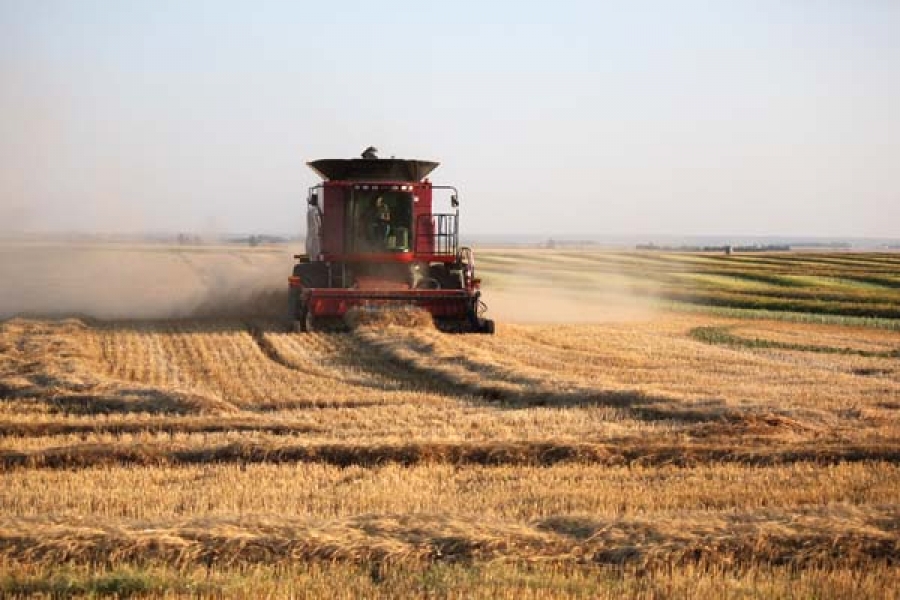
Despite all of these factors, farmers have started to hit the land to bring in the crop that was able to grow this summer. Reports from Manitoba Agriculture state in the southwest region, crops are turning quickly due to hot and dry conditions.
Winter wheat and fall rye are mostly harvested. Yield is average and quality is good. Early seeded spring cereals have also begun to come off the field. Pre-harvest applications and swathing is ongoing, with yields difficult to determine at this point. Different reports on quality are coming in. Low bushel weights have been reported in oats and barley.
Canola is turning, with swathing well underway. Where there has been little rainfall plants are short and some pods aborted.
Field pea harvest has started with average yields of good quality. Plants look good with few disease issues. Flax has completed flowering and begun to turn.
Most soybean crops are in R6 stage, with many fields showing moisture stress on hills or light land by dropping leaves or leaves and pods browning. These fields could use some rain.
Sunflowers are in R5 or R6 stage, corn is tasseling and starting to fill cobs, and both crops are starting to show stress from heat and dry conditions with curling and browning leaves.
Pastures are fair to poor in most areas. Some producers have started supplemental feed on pastures. First cut of hay is done in most areas, with some second cutting. Haying is also happening in sloughs because of dry conditions. Dugouts are about 40% full with some farmers having to supply water to pastures.
The forecast has hot temperatures until the weekend, then some relief coming the following two weeks. A little rain is in the forecast for this weekend, and then about 10 mms is predicted for August 25-26. But that is a long time off.
by PAUL RAYNER, Recorder staff