
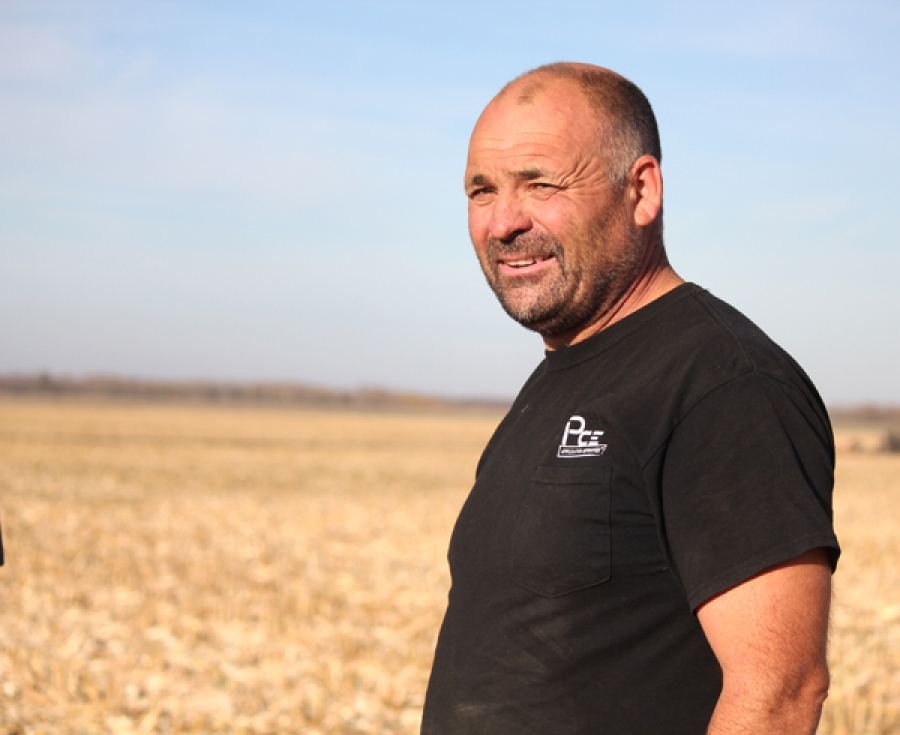
The manure applicator business has been around since 2000, with Bell as owner operator for the last five years. His beginnings go farther back. A native of England, Bell came to Canada first in 1984, following a former employer.
“David Stead moved here in 1983,” Bell explained, “and I had worked for him in England. I was finished school so I came here the next year. The opportunity came to see what the other half of the world was like.”
For a few years, he would winter back in the UK, and once all of the paperwork was settled and he had made his decision, he came full time in ’89. He worked at Stead’s dairy farm for a while, and then moved on to the Hildebrand brothers. Sid Patterson, originally from Ulster, approached Bell with an idea about a hog manure application company and asked him to come with him. He said yes, saying he did not want to be a hired man all his life and was used to doing custom work back home. He was there when Redhand started.
“I was there before the first piece of equipment was bought.”
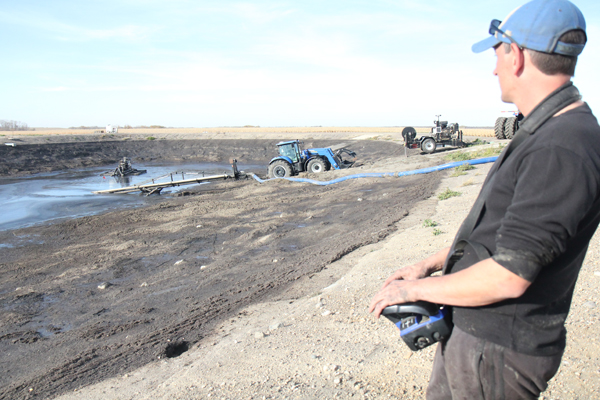
As Bell explained, Redhand cleans out lagoons for hog barns. They agitate manure to get it to the application state, then they can apply the manure to a field. Although some might not think so, this by-product of the pigs can be pure gold.
“A lot of people think of fertilizer as waste,” Bell said, “but it’s not. It’s a fairly common and expensive commodity. I’ve noticed now that land increases in price around hog barns due to the manure. They realize the benefit of manure to land.”
Redhand itself does not buy or sell the manure, but is hired by others to move and apply it. Bell said that system is helpful to them, because it keeps them out of the politics end of the dealings.
“It helps us with the relationships with the landowners. They aren’t asking us ‘why did it go there and not here.’ We just send it where we’re told. It helps with landowners and we are always striving to build relationships with landowners.”
He added he has been going to some of the same sites for 18 years now.
They move from site to site, but try to do all of the work at one site before cleaning up and moving on for animal health reasons. Due to different factors it might not always work, but this is what the aim is. Everything is cleaned and disinfected before moving to another site.
A lot of equipment is obviously used to do this work, and it does change over time. For example, they used to use what are known as conventional agitators to work in the manure. But Bell said they caused spikes in fertilizer levels. Now they use remote controlled “boats”, which give a more consistent product. Each crew has a boat they move from lagoon to lagoon, while they also have backups.
There are a lot of regulations for applying fertilizer. Redhand has a company they work with that lines up land for them, but that is just the beginning. Farmers have to put in manure management plans, which are sent to government. Soil samples are taken, digital maps are made, more plans are put together, and so on. There is even a legal date before any manure can be applied. So nothing happens in a vacuum.
Soil samples, which will tell what fields need fertilizer and at what level, are key. Bell said they could not make a move without them. This means getting them done and the results back promptly can be a challenge. Redhand was having difficulty in that regard, so they decided to do their own samples, starting a couple of years ago.
“It’s such a time sensitive business,” Bell said. “It helps us get into the field quicker. We can get our trucks out there. It helps us to get the results in to the lab quicker; because once it gets in to the lab it takes three or four days. We can’t go without that result.”
Since they have the equipment, Redhand also does independent soil samples for others. Because they do not sell fertilizer, it is easy for them to give an unbiased opinion.
A third division of the business is maintenance work on the barns themselves. Bell said this got going to help keep the workers employed during slack periods. When not in the fields, the crews can go out and do day to day maintenance, change doors and windows, even work on frozen sewer lines – whatever needs doing. He said that side of the business comes and goes.
Bell worked for Patterson for a few years, then the business was sold to Scott Rose and Trevor Cowieson. In 2013, Bell took ownership.
“It was a natural transition. The opportunity came up. It was an easy transition, really, because I knew the business inside and out.”
He has around twenty employees on average. They run two crews of seven people. They run 24 hours a day, with normally four during the day and three at night. He has family involved, with son Josh back with the company and daughter Jessica doing the books. Also, employee Brad Campbell is working his way into the company on a share basis.
Redhand usually runs twice a year in Saskatchewan, spring and fall, as they cannot apply fertilizer in this province until April 10. He is a little concerned about this spring, as there may be delays with the heavy frost in the ground.
“The farmers’ equipment is bigger now and they can catch up to us pretty quick. We have a small window for this.”
Overall, Bell sees the hog industry going well. More sites are up, there is a feed mill in Killarney and both killing plants in the province are now at 24 hours a day. Redhand did about 31,000 acres on the manure side last year, and he said the business keeps growing each year. They are seriously looking at adding a third crew in the near future. Everything looks good and Bell sees himself continuing for some time to come.
“I don’t foresee us going anywhere for a while yet,” he stated.
by PAUL RAYNER, Recorder staff