
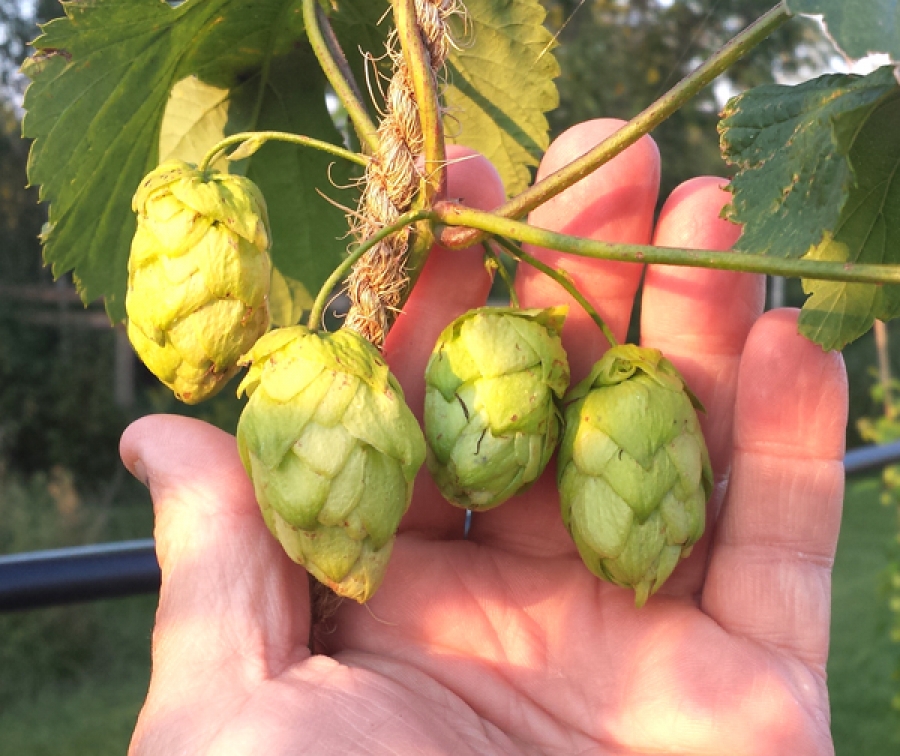
Randy and Lyn Tye have started Prairie Mountain Hops and will soon begin producing the crop commercially for the craft beer market. It is a growing industry with many possibilities for the near and farther future, and the Tyes are really getting in at the ground floor from the local perspective.
They have a small plot of land, about 40 acres, south of Boissevain in the Turtle Mountains. Randy Tye said the idea of growing hops arose from a desire to do something on that land that would keep them moving in later years.
“For some time, we were looking for something to do on our smaller acreage,” Tye explained. “We wanted something that would generate revenue from our property. We were looking at different things, something that would transition us to retirement.”

They did research and decided to take a chance on hops. Tye said they grow like an orchard, and he always enjoyed plants, so it was a natural choice.
“Livestock ties you to the farm, with chores. But hops are like an orchard. Once you get the structure up, you maintain them and harvest. It would get us outside on a regular basis, and keep us mobile into the future. It really is an exciting time in the craft brewing industry.”
About a month ago, they committed to the concept of growing hops.
Hops are grown on a V-trellis system, and Tye said eventually they would commit 12-15 acres of land to this. Vines grow up the trellis, which has a pole 19 feet high. Each trellis would be 12 feet from the next. They begin growing as soon as the ground warms up, and Tye said they are one of the most aggressive growing vines. On the best day under the best conditions they can grow a foot a day.
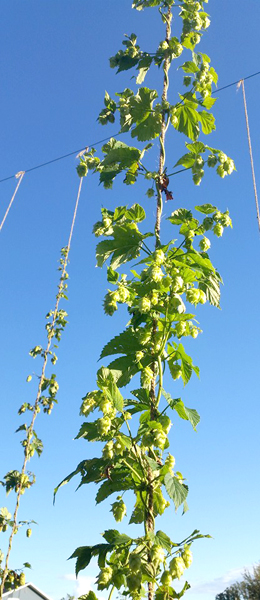
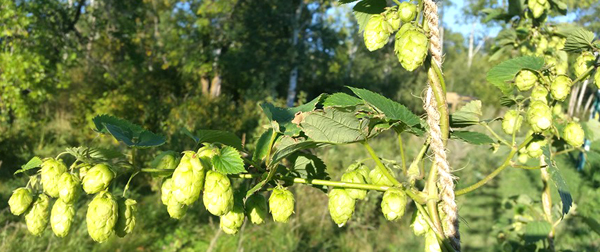
From the main vines come sidearms, which should be up by June 21. On the sidearms come the hops, which when fully grown, resemble a pinecone. They are harvested in early to mid-September.
Tye said there is a market for what are known as wet hops, directly from the vine, from brewers who make seasonal beer. However, most are sold after they have been dried and ground into pellets, which are then vacuum-sealed and frozen. It is the yellow coloured inside which flavors the beer.
“Really, we are making a spice which is used to make beer,” Tye explained.
Hops have been used for thousands of years, as long as people have been making beer. Tye said they were originally used as a preservative, which allowed beer to be sent to other parts of the world on ships without going bad. When they put it in, they were what produced the bitterness of the brew. In North America, hops were grown in US states like Wisconsin and New York, but were moved to the drier Pacific Northwest 80 years ago because of disease factors. Now we have better varieties and disease control, and they are making a comeback in the east. Tye said hops like to grow around the 50th parallel, and since we are on the 49th, the climate should work well, with 120 frost-free days.
Although it seems like a new product, hops do grow naturally here. In fact, Tye said, the types he will be growing have a history in this very area. This year will be the 200th anniversary of a cutting of an American hop, which is actually from Southern Manitoba, being sent to England to be cross bred with their native ones. This is where some of the first aroma hops, used for greater flavor in craft brews in particular, came from. Since these aroma hops are what will be grown on the Tye property, it is almost a homecoming.
“Since hops grow from roots and cuttings like a potato instead of seed,” he explained, adding they will be getting their plants initially from Michigan, “the live root or cutting we will be planting now will be related to the wild hops growing in the field. It’s very unique.”
They will be starting with two acres this year, with the Michigan plants. In the summer, they hope to put up a greenhouse, where they will start enough plants for the next year, when they will be putting in four more acres. By the third year, they are planning to have their pelleting plant, where they can do all of their own pelleting and packaging as well as eventually do custom work for other hop producers. There is also the possibility of growing plants for sale to others who want to grow their own hops.
There are about 100 varieties of hops, with about half of them being aroma hops. For craft breweries, several different varieties might be used in a single beer. Tye said they would not likely supply a brewer with every ingredient for a beer, but maybe two or three to different brewers. They did some growing last year to see which varieties did well and will be concentrating on popular ones called Centennial, Cascade and Willamette, with some space given to others they want to experiment with. A plant will last 15-20 years, but sometimes they are changed anyway as demand for different varieties drive the industry.
“Success is being able to forecast what varieties will be popular.”
It is hard to predict how much the plants will produce, but Tye said USDA numbers suggest that most varieties produce an upward of 2,000 dried pounds of hops per acre. They will be planting about 1,000 plants per acre.
It is labour intensive. Tye said they would have to be out with the hops every two days to check for pests and diseases. Fertilizer and control will be helped by their irrigation system. But the amount of time spent is why they are only committing a maximum of 15 acres.
They are expecting to hire seasonal workers. For example, when the plants begin in the spring, they have to wrap them around strings to train them where to grow. This takes about ten days. Then harvest, when the vines are cut down and taken to a stationary harvester, will also need hands.
“There will certainly be opportunities for seasonal help.”
There is no question of market. Tye did plenty of research before they started, and was in contact with many breweries in the prairies. The craft breweries are not only particular about flavors and quality, but are sensitive to locally grown product. For consumers to know where their food and beverages are produced is of growing importance, and Tye said their key market of brewers in Manitoba and Saskatchewan are interested in what they will be producing.
“If we can provide a quality product that can compete,” Tye explained, “I believe we can access that market.”
As well as brewers, there are also home brewing customers and beer stores that cater to them.
Tye said it is an exciting time to be involved with the brewing industry. As well as the smaller craft brewers, the larger companies are going with flavored brews to go with their big lines. Some pubs serve different brews all the time. Customers are getting to be more adventurous in what they drink. In fact, beer drinking is getting more and more like wine tasting or scotch sipping, with people trying new varieties and changing favourites all the time. Tye said by the end of 2014, the US had granted 4300 hop-growing licenses, the most ever, and it continues to grow.
“There is still that great desire to try something new. I don’t think the flavoured beer industry will ever go away.”
He feels Prairie Mountain Hops has a chance to become a part of this ever-growing situation.
“The market is there,” he said, “and we hope we can satisfy it.”
by PAUL RAYNER, Recorder staff