
Why did he decide to make the plunge? Dalrymple said he did not like the options at Drings, and wanted a chance to expand his horizons, which he did.
One of his first impressions was when he was leaving from Winnipeg to CFB Cornwallis for basic training. The long flight meant he got to know a few people who like him had just joined. Once they got to their base, one of the first things they did was had their army haircuts. Once they were done, they hardly recognized each other.
“You’re not the same guy,” he laughed. “You had to make friends all over again.”
He did a few months at Cornwallis to do the most basic marching and saluting and some of the weeding out of those not meant for army life happened there. Dalrymple then moved on to battle school at Gagetown, New Brunswick for three or four months.
When that was done, he headed off to Montreal as security for the Summer Olympics in 1976 as a part of 2 Royal Canadian Regiment. When the athletes showed up, they escorted them around, and he met some royals. They stayed at the village with the athletes. Apart from some trouble with doves that would not leave the stadium, it was an enjoyable experience.
His first overseas deployment was a little more serious. The year after the Olympics, Dalrymple was sent to Cyprus as a part of Canada’s contribution to the UN Peacekeeping force for six months. Fighting between Greeks and Turks on the island meant there was a need for a buffer zone. He said it was an eye opening experience. They would be serving at operational points between the warring sides. They would talk to both, and could do some trading with them. Dalrymple said there was no major fighting when he was there, but there would be some desultory firing at times, which they would have to report with details. He added there were no preferences between Greeks or Turks.
“You’re UN, you’re in the centre, there is no difference between them.”
While at Cyprus, Dalrymple remustered. After an accident prior to deployment, he had some leg trouble, so he moved on to fire fighting. This was a new career that would stick with him for the rest of his time. He did his fire fighting training at CFB Borden.
His first posting as a firefighter was to CFB Cold Lake, Alberta. An air force base, Dalrymple said he saw Prime Minister Pierre Trudeau fly in with the first batch of F-18 fighters.
At Cold Lake, Dalrymple saw some bad crashes. One of the planes they flew then was the CF-104, known as the Widowmaker. As a firefighter, he was first on the scene for some bad situations, which can be very sobering and remind one of how life moves quickly.
A change of pace happened then. He was asked if he wanted to go to sea. Saying yes, he was attached to the navy and joined HMCS Huron as a firefighter.
“It was fun,” Dalrymple said. “We had good crew, I was young, and it was fun.”
They went to Bermuda, Puerto Rico and all down the US eastern seaboard. In 1982, they went to Plymouth, England. There they had to turn over all their anti-flash gear to the Royal Navy. They needed it as they were heading off to the Falklands War.
In fact, Dalrymple served overseas on many different deployments. There were four years in West Germany in the 1980’s, where Myrtle and his daughters lived with him. This was during another high point of the Cold War, and he was often called in for exercises in the middle of the night. There would be a knock on the door, and he would have to head in to the base. One never knew if it was a practice or something was really up. Myrtle said everything would be locked down during those exercises, and admitted it was a tense time.
He visited Vladivostok, Russia with HMCS Annapolis, found some Vietnamese refugees out in the ocean, kept the peace in Syria in 1995 and served in the Gulf in 2000 checking ships. It was a long and varied career, one that led to BC and teaching firefighting aboard ship. He retired in 2005 after 30 years at rank of sergeant. Dalrymple said after a few years, it becomes a career. There were tough times, but the good times outweigh the bad. Myrtle added the armed forces were very good at looking after the families.
Eventually, the road led back to Boissevain. It was a return to roots and people they knew.
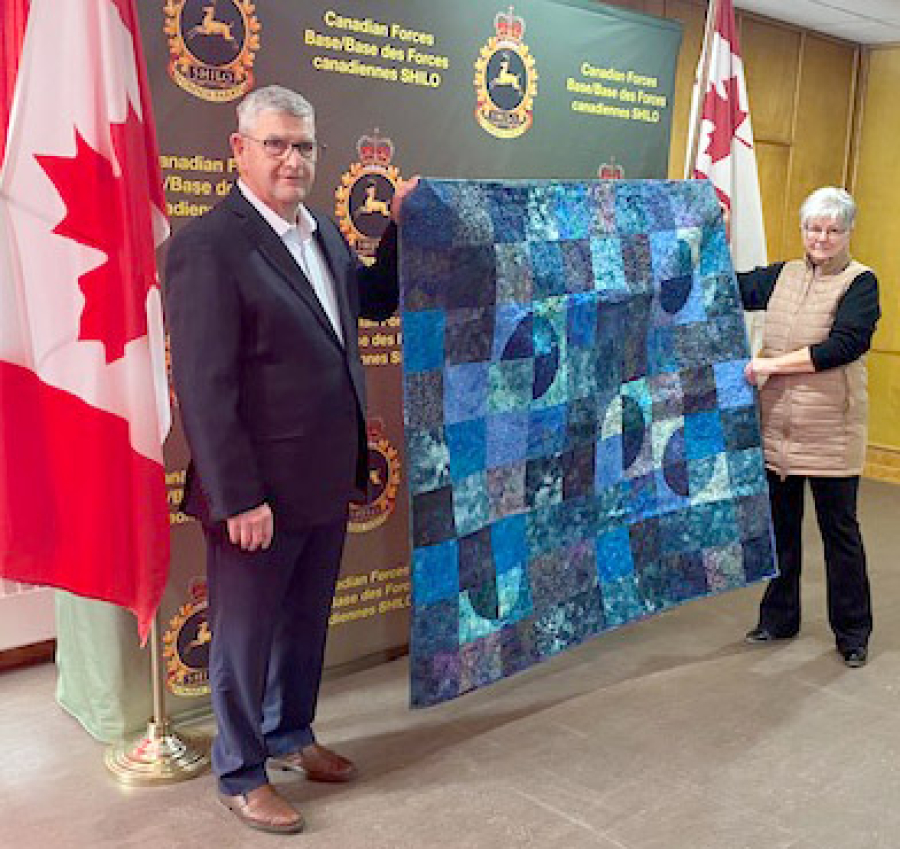
The Quilt of Valour is a nice cap to a career serving his country. Murray said he was proud of his time in the military, and Myrtle said he should be.
“I’m proud of Murray,” she said. “He’s done a lot. It was a good career for Murray to take care of his family. He served his country with honour.”
by PAUL RAYNER, Recorder staff