
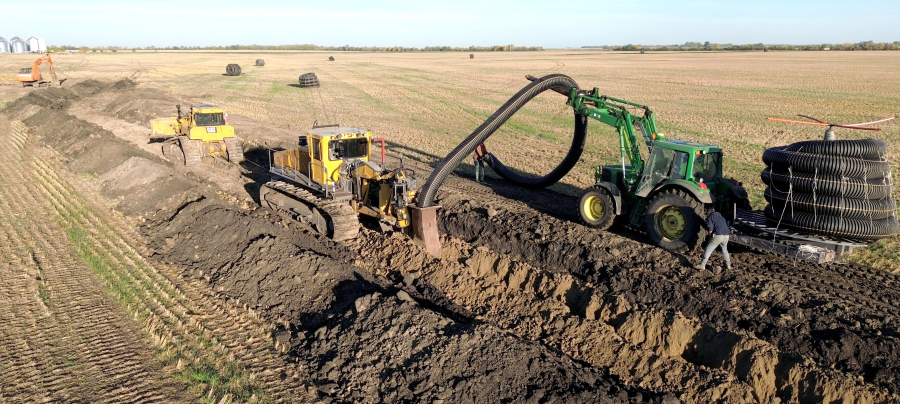
Tile drainage is a type of water management that targets the sub-surface water, removing the excess from under the soil. Whereas ditching and pumping can remove surface water, tiling is best for underground. The term comes from the old clay tiles that were used for this purpose in earlier times. As Mealy explained, it has a similar purpose as weeping tile in a house, removing water that is underneath.
Piping is laid under the field, and often includes a main line, which will take the excess moisture out to a ditch or a controlled drain.
There are many advantages to the system. Removing the excess moisture will allow a producer to access their land earlier in the spring. This gets the crop in earlier, which makes for a longer growing season. It will also protect from a big rain in the middle of the year, as it takes out what is not useful. Mealy said this is a kind of “insurance policy” for a field.
There are added benefits. When the water table just under the ground is lower, plants will reach down lower looking for moisture. Those deeper roots make the crop not only stronger and more stable, but help out during dry years, as they can get what they need from the land’s water reserves.
“Those roots are deeper and can chase the moisture,” Mealy stated. “When you look at a tiled field versus an untiled field, the tiled field has deeper roots.”
This can help with yields. Tiling can help with the salinity of the soil by removing salty water and therefore unproductive alkali spots.
Some concern has been shown regarding flooding. As tiling involves the dreaded term “drainage” people often think a tiled field will flood neighbouring land. Mealy said it could actually help as it slows down the flow of water through the tiles. It also helps with absorption.
“You’ve turned your land into a sponge. A tiled field can absorb more.”
Mealy said they do the whole process, including working on the permitting. This can be a big challenge as there are a lot of regulations for surface and sub-surface drainage. He does not begrudge the rules, as they are in place for a good reason. It just takes time and effort.
They will survey the land using GPS mapping to see where to put in the pipes. They have the full range of equipment to install the pipes, which can take about a week if all goes well.
Impact serves western Manitoba and eastern Saskatchewan. They work with the Saskatchewan Water Security Agency on permitting. Mealy said part of the reason the business has expanded to the west is there are not a lot of companies out that way doing tiling. As their land prices are moving up as ours are, there is more demand to improve property.
One aspect they are noting are customers tiling one field, but also doing the survey and permitting for future ones. It is a way to plan ahead for an overall land improvement.
Impact has worked to educate producers in the importance of tiling. In the fall, they held a “field day/open house”. Producers came out to a local field they were tiling to get a look at the work. Then they headed over to the Minto Community Hall to learn more about the process and benefits, as well as to ask some questions.
“It was a really good day,” Mealy said. “They were able to see how we work first hand. We had people from the different municipalities there to see it, which is good because they are the people who sign off on it. I think it was beneficial to a lot of people, a really good day to promote tiling without question.”
Winter is the time for designing and permitting. In the busy season, they will bring on three more full time workers. Producers will soon be making decisions, and Mealy said they expect a lot of work ahead of them this year.
This should also move into the future. As he explained, the last he heard, Manitoba was only two percent tiled. With other provinces and US states further east either at majority fields or approaching it, there is certainly a market.
“There is certainly a lot of opportunity as the land prices grow. We can only grow so fast, but it is trending up, which is the main thing.”
by PAUL RAYNER, Recorder staff