
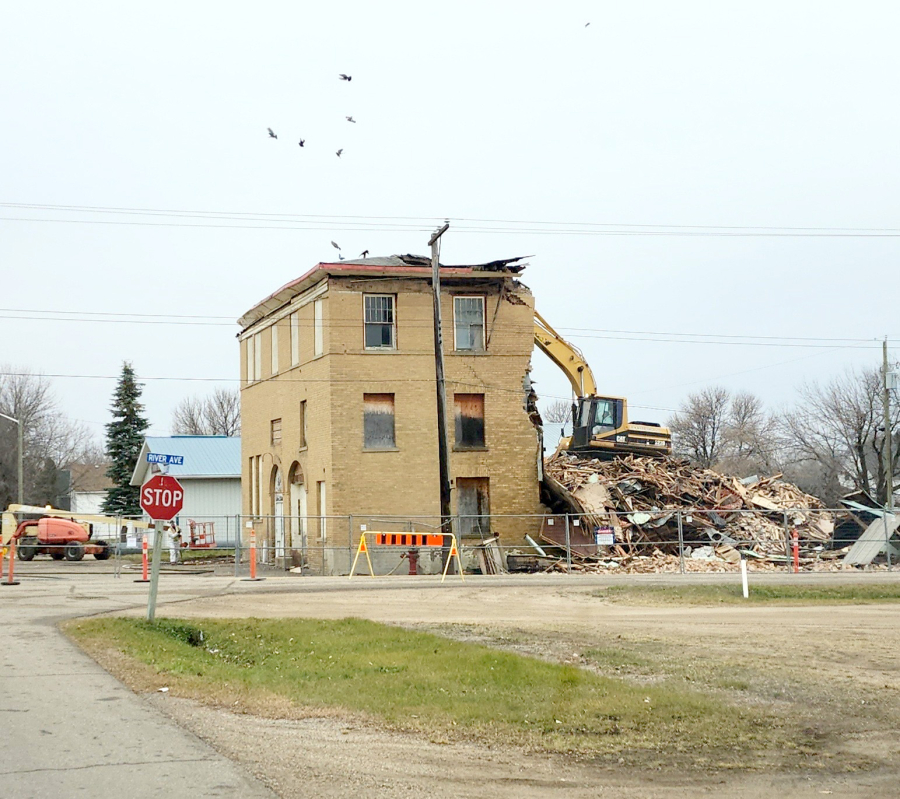
According to the Municipality of Grassland, a Cursory Building Condition Assessment was completed by Burns Maendel Consulting Engineers which identified significant structural issues and recommended demolition as the safest and most cost-effective option. The project was awarded to Restoration Manitoba, a construction company out of Brandon.
Grassland said that the Municipality has applied for $125,000 through the Manitoba GRO Grant program and any remaining expenses will be funded through the Gas Tax Reserve Fund.
Once the site is cleared of debris, the location will be transformed into a memorial park, with the original Town Hall bell and sign installed at its centre, preserving the spirit and history of the structure for future generations.
Back during the turn of the century, when the 19th was growing into the 20th and small towns of settlers were forming all over Manitoba, the idea for a town hall came about. After a handful of fires that damaged houses and businesses, and one that destroyed most of main street, citizens wanted better fire-fighting capabilities, as well as a new social gathering place. It was determined that the best way to get these things was to incorporate into a town to have better access to public funds.
According to “The Mere Living: A Biography of the Hartney District” written by Hazel McDonald Parkinson, and published in 1957, May 1904 was when a petition to incorporate was signed and forwarded to the provincial government.
By January of the next year the town of Hartney was created, and by March it had a council and mayor. In August 1905, a by-law was approved for $7,000 to be spent on building a new town hall and for fire protection. The building was to cost $4,000, with the remaining $3,000 to be spent on a modern gasoline fire engine, a fire hose, and two underground tanks for water. The building was to be a two-storey brick structure including a fire hall with a belfry, an auditorium seating 425, a stage, two dressing rooms, and a kitchen.
At first, council elected not to finish the second floor right away, but after another fire in November 1905, the building where the Odd Fellows, Masons, and Knights of Pythias had their lodge rooms burned down, and the groups requested that the second floor be finished with the building.
Before the building could be constructed, it was determined that to furnish the auditorium with seats and finish the second floor would cost an extra $4,500. The question of where this extra cash would come from caused a lively debate amongst council that spilled into the pages of The Hartney Star.
Councillor F. Chapin opposed the idea of issuing further debentures, but the other councillors overruled him and arranged a by-law to provide the extra money. Chapin was still not pleased with this and advocated for making the building and auditorium smaller to stay within budget instead of “saddling the citizens with heavy taxes”. He warned that if council borrowed the money, it could force them to pay the whole thing back in one year.
His loudest opposition in the debate was W.E. Crawford, who said that Chapin’s fears were unfounded because making ratepayers pay more than one cent on the dollar was illegal, so the most that they would be charged is $3,000 in one year. He argued that the smaller hall was not good enough, and that it would not accommodate a paying audience. He said that a smaller stage would not permit a good performance, which could cause the better entertainers to by-pass Hartney.
“Let us have a good hall, or none at all,” he wrote in The Hartney Star.
By April 1906, ratepayers voted in favour of keeping the original plan and spending the extra $4,500, which ended up costing taxpayers only $4 on every $1,000 of assessment, prompting construction to finally begin. It was completed in October 1906 and was in constant use afterwards and the rental fees helped fill municipal coffers, reassuring ratepayers that it was worth the extra funds.
“After the hall was built, the use of the town hall was a unifying influence,” wrote Parkinson in “The Mere Living”, “The hall brought the farm folk, living in separate districts together for plays, concerts, fowl suppers, for meetings of general public interests, and for memorial services. Standing strong and sturdy on its corner, surmounted by its square bell tower, the town hall is a monument to the foresight of the council and citizens who erected it and is still the centre of Hartney’s public life.”
by JACQUIE MAYNARD, Recorder staff