
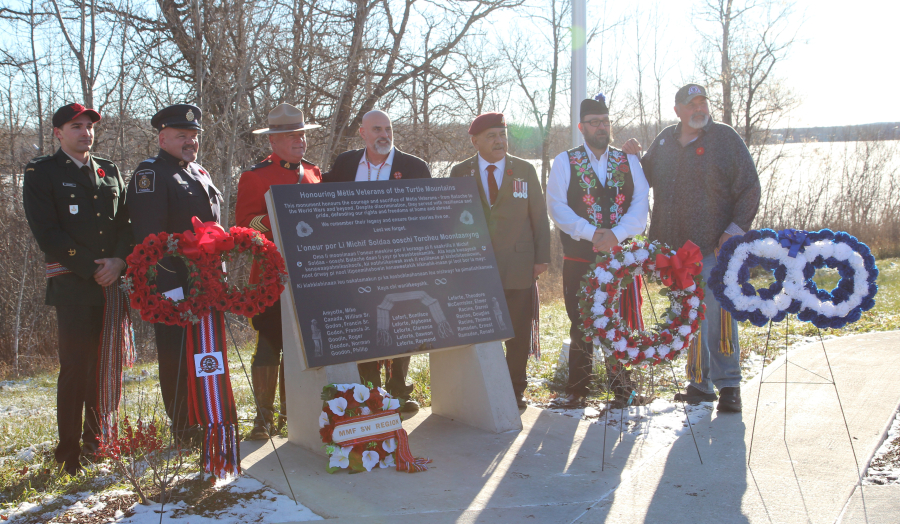
The event began with an opening prayer from Elder Jackie Leforte and Master of Ceremonies Sharon Parenteau welcomed everyone. She said that Métis served in every major conflict that Canada has been in and enlisted in the thousands, although only “status Indians” (which Métis are not) were recorded, so history may never know the true number.
Manitoba Métis Federation Minister Jack Park, who is also a veteran and chair of the Métis Veterans Legacy Program, continued this sentiment, saying that “we believed in this country, even if it didn’t believe in us.”
According to the Government of Canada, around one third of First Nations people in Canada between the ages of 18 and 45 enlisted during First World War, a number which does not include the estimated 4,000 Métis and Inuit soldiers who also signed up.
After returning home, Indigenous veterans were not awarded the same benefits as their non-Indigenous counterparts.
Speeches from dignitaries at the event echoed this sentiment, including MMF Minister Shaun Nault, who is also a veteran. Ken McGregor from Canada Border Services Agency, Terry Lucier from the RCMP, and active duty soldier Dawson Leforte were also present.
Turtle Mountain Métis Local Chairperson Chris Leforte, along with Linda McNarland and Tim Inkster removed the flags to unveil the monument, which was created and installed by Sheldon and Laura Dyck. A message of remembrance is inscribed on the monument in English, as well as in Michif, which was read out by Verna DeMontigny, Michif language teacher. Afterwards, Minister Nault, Dawson Leforte, MMF Minister Will Goodon and Brooklyn Anderson laid wreaths at the foot of the monument.
Dawson Leforte, 26, enlisted with the Canadian Armed Forces at the age of 22 and is just finishing up his contract. He said that he loved being in the military and his experience is one he will never forget. He was deployed domestically on the east coast to help support Prince Edward Island in the aftermath of Hurricane Fiona, and participated in many training exercises, including some with militaries from other countries.
In comparison with his ancestors and relatives who served in World War One, World War Two, and the Korean War, he said that the army these days is very inclusive. While he holds his culture close to his heart, he never felt like anything was different for him because he is Métis.
“We are all suffering together,” he laughed. “In the army, we have to be homogenous or it doesn’t work.”
The memorial monument was made possible by the Métis Veterans Legacy Program, which helps to support and expand the efforts that Métis communities have traditionally undertaken to honour their veterans. It invites and enables Métis citizens to undertake projects that promote awareness and preserve the legacies of the men and women who served and defended Canada.
by JACQUIE MAYNARD, Recorder staff