
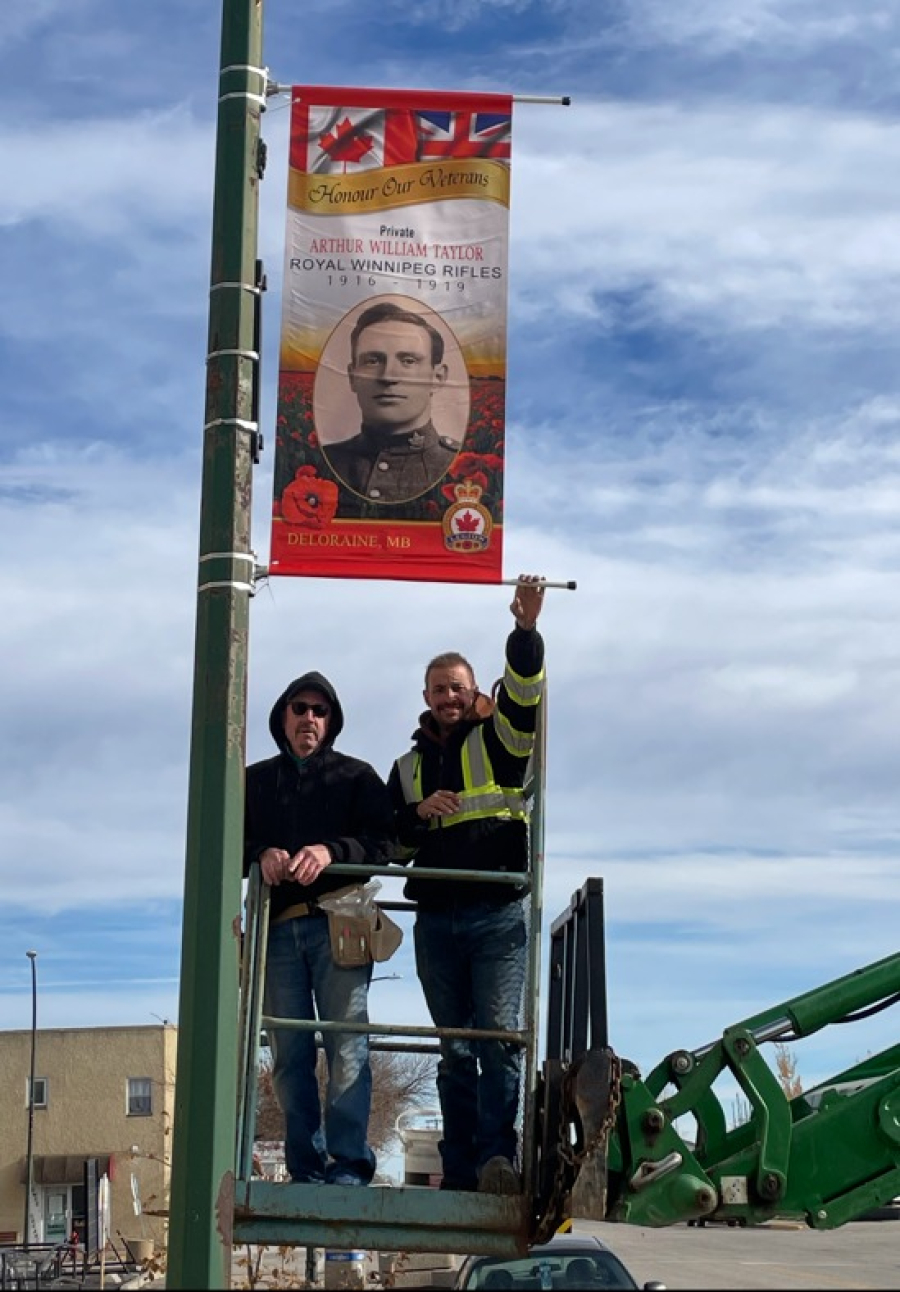
It has taken a while for Manitoba Hydro to give permission for the banners to be put up on the poles, but now that they are on display, Carlson said that the reception has been great. In fact, six or seven more families have said they would be interested in having banners for their family members.
Each banner and part of the hardware for hanging it, a cost of around $340, was sponsored by the family, with the Legion footing the bill for the remaining hardware. The maintenance crew for the Municipality of Deloraine-Winchester helped hang the banners with their tractor.
This year, the veterans being honoured are: Keith Maxwell, Orville Russell and Jack King (paid for by the King family), Garth Combs, George Wintle, Arthur Taylor (paid for by Linda Garwood-Filbert), Don Hasselfield, Don Bolduc, Kenneth Bolduc, and Les Lowdon.
The banners will be up until mid-November, when the municipality will put up its Christmas decorations, and will be put up again next year, hopefully with more additions.
A Remembrance Day service will be held at the Deloraine Legion on November 11.
The Bolduc family is happy and proud their father is being honoured with a banner in Deloraine.
Flying Officer Donald Joseph Bolduc is one of the veterans with a banner hung recently in his hometown, remembering his service. His experience is indicative of the courage of our young men and women and the sacrifices made in service of their country.
Bolduc was born in Lampman, Saskatchewan near Estevan. He attempted to join the Royal Canadian Air Force at age 17 as he always had an interest in flying, not unusual for young men of that age. He was initially turned down, but was accepted in November, 1942. In a presentation he made to his daughter Donna Jean Lamb’s school classroom when she was teaching, he said he was given a uniform and taught to march. He was chosen to be a navigator and not a pilot. As he explained, a navigator is a very important person in a war, as he tells the pilot to where to fly and how to get to the destination. Bolduc told the students it sounded easy, but there are no street signs in the sky, and you had to learn to look for landmarks like lakes, rivers and roads and use a special map.
Bolduc learned Morse code in Calgary and navigation in Quebec City before moving overseas. He was the navigator in a De Havilland Mosquito Fighter Bomber Mark 6. This wood-based aircraft was famous for its many uses, and had a crew of two, the pilot and navigator. As Bolduc explained to the class, it could carry two or three 500-pound bombs and had four machine guns and four 20 mm cannons.
Doing a lot of night flying, he said he had a flashlight covered in paper with a small hole poked through it to see maps. It was important to keep light out of the cockpit as it ruined night vision and made the plane more visible in the air. The pilot dropped bombs and fired the guns, while it was his job to make sure they did not fly too close to the ground during missions. He related being fired on, saying it was like “fingers of fire heading straight for you.” They were fortunately never hit.
He added it was about a four-hour trip from base and back during missions. He had a parachute between his feet and a small table containing his maps and log book in his lap. There was a small survival kit with some medical supplies and food, and their instructions were printed on rice paper so they could eat them if they were captured.
One highlight was participating in a church service with the Count of Ribaucourt, staying at his Perk Castle in the Brussels, Belgium area. Bolduc and his wife Rose would later stay there during their 25th anniversary.
After the war’s end in 1945, Bolduc would spend time in England before his discharge in March of 1946. He passed away in August 2020 and Rose in February of 2022.
Lamb said the family was thrilled to see their father honoured with a banner.
“Our family has always been proud of Dad’s time spent serving his country in WW2,” Lamb stated. “To have him recognized with this banner is a wonderful way to pay tribute to his years of service. We really appreciate everyone who contributed to this effort.”
by PAUL RAYNER & JACQUIE MAYNARD, Recorder staff