
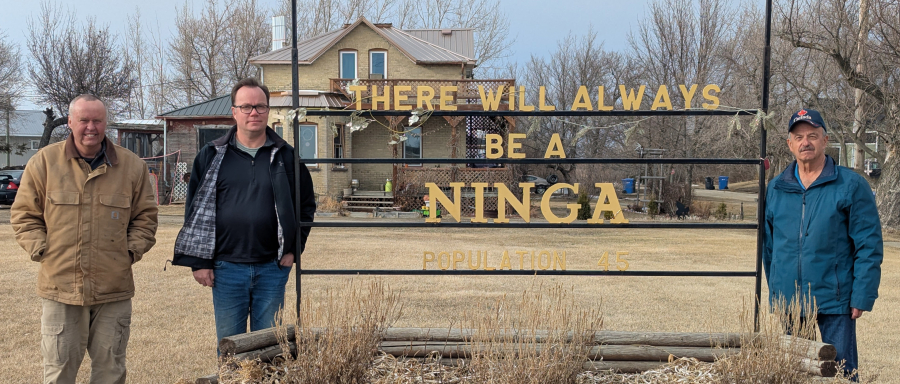
Essentially, an LUD is like a mini council: three elected officials facilitate a town meeting to share and gather information and opinions from residents, which helps them create a service plan that is approved by municipal council. Funds for this service plan come from taxes and a special reserve fund, but ultimately resources and decisions come through the municipality. At present, Ninga’s service plan includes streetlights, town beautification, and mowing, which cost the municipality $8,190.32 in 2024, nearly $1,600 less than what was budgeted thanks to the ingenuity and sweat equity of residents.
Dedication from Ninga’s residents is what keeps the community alive. Last summer, each street “adopted” a pot of flowers on their corner and some adopted a flowerbed, as well, and every spring a “town clean-up” is scheduled. Local families take up the responsibility of planning events, taking care of the rink, and making sure Ninga Rec Hockey sticks around for another season.
Some of the volunteers with the longest tenures, however, are on the LUD board. Ed Epp has lived in the area his whole life, and served on the board since the mid-1980’s along with Richard Pugh, another Ninga native, and Tony Beard from Boissevain, who joined over 25 years ago after he and his wife moved to the community. Recently though, there have been rumblings that a member of the board would like to retire, sending a small tremor of fear through the community.
What if no one steps up? What will happen to the community then?
During the last annual general meeting, Assistant CAO for the Municipality of Killarney-Turtle Mountain Brittney Ross let residents know that if a member retires and two general elections passed without anyone running for the board, the LUD would be dissolved, however, to hold an election would cost the LUD at least $2,000. Now, the mostly aging population of the community has a choice, and so do the handful of young people who live there: get involved, or allow the LUD to dissolve.
While the municipality has not said so directly, it makes sense that it would make things easier for them if the Ninga LUD were to dissolve, since council members representing the municipality donate their time to attend meetings, among other things, and it may save on some administrative hassle. After all, Ninga lies along the furthest western border and makes up only 1.8% of Killarney-Turtle Mountain’s population. Officially, “the municipality has provided all relevant financial and procedural details to the Ninga LUD to assist in their decision-making process regarding potential dissolution. We respect the LUD’s autonomy in this matter and fully support their decision, whichever path they choose. If and when the LUD is ready to proceed, the municipality remains committed to providing any necessary assistance and guidance.”
The general consensus among residents, though, is to keep things the way they are.
“I feel like the issue is to find people to run,” said Epp.
While that is true, it is not the only issue.
“I think eventually it will most likely be more beneficial for us to dissolve and be in the municipality,” said Pugh. “There are many benefits we get that they don’t charge us for, and if they did it would be unaffordable for us as an LUD, but we would lose our community direction on things like the park, flowers, and mowing.”
Citizens are finding it difficult to give that up. Beard agreed that for now, he thinks Ninga should stay as an LUD since it gives the community the freedom to make its own choices, but that costs might get too high in the future.
Ratepayers in Ninga may see a decrease in their taxes if it dissolves. According to the municipality, for a residential property assessed at $150,000, including garbage and recycling pick-up, the municipal tax bill with the Ninga LUD works out to $1,492.73. If the LUD were to dissolve, that same property would pay $1,226.17, which is a decrease of 17.86%, or $266.56.
Although it is undeniable that the town sees less traffic after the loss of the grain elevator in 2001 (which has since been sold to Mayfair Colony) and the closing of the Country Corner Café after COVID, the remaining population still love where they live and community direction is very important to them.
“It does seem like the majority want to stay in order to keep our community direction,” said Pugh. “Unless it starts to cost us.”
Luckily, the community still has room to grow. While a portion of the population is nearing retirement age, there are still families with school-age kids, as well as visiting children and grandchildren, so during the summer months it can hardly be considered a “quiet village”. In addition to several empty lots and reasonable taxes, Ninga has potential if it can attract the people, and along with them, the resources.
Even if, at some point, the community makes the decision to dissolve, it is not a simple process: to start with, it involves a petition where at least two-thirds of the 44 voting members have to agree, and once that is done, the paperwork can begin. After that, community members can get together and make recommendations to municipal council, but ultimately, the municipality would make the decisions.
While Epp agrees that the future of Ninga is uncertain, it is not because the community does not care.
“Sure, we don’t have all the amenities, but it’s nice to be in a small community,” said Epp. “We are fairly tight-knit, our community life is good.”
by JACQUIE MAYNARD
Recorder Staff