
He said they started serious thought and work on the project about a year and a half ago. The group is no stranger to making historical films of the region, and were just completing their latest, “The Barn” about the Chain Lakes area. They have been socking away about $4,000 a year for filmmaking, and received a $17,000 government grant last year. The stage was set.
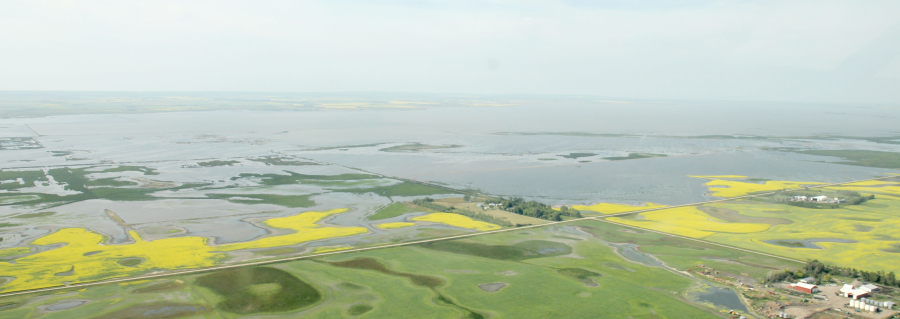
The lake is about 12 miles long just north of the Turtle Mountains. According to volume one of the history book Vantage Points, put together by the TMSPHA, the plains around the lake were well known to Assiniboine and Metis people for grazing herds of bison. Bison hunting was important in the area, with the last being seen around 1883. It was also a nesting place for whooping and sand hill cranes.
Whitewater has a unique character. With only dubious outflows at Elgin and Medora Creeks, and inflows from the Turtle Mountain, it is heavily influenced by the situation around it. If it is a wet period, it will overflow its non-existent banks. If it is dry for a long time, the lake will literally disappear. According to Vantage Points, a historical map shows a trail made by explorer Alexander Henry Jr. in 1806 cutting through what is now the lake, and First Nations elders have spoken of the same dry conditions.
As Neufeld explained, when settlers came to the area and started farming, the chameleon character of the lake began to have more of an impact. By 1913, there was only a puddle left, and government surveyors said the land should be sold for $25 an acre. Soon thereafter, wet years made the lake expand again. In the 1930’s it was dry. By the mid-1970’s, it was reaching Boissevain. The next decade it was dry enough that waterfowl hunting was threatened. Whitewater was in constant fluctuation.
In the 2000’s, particularly in 2006 and 2011, the lake expanded dramatically, swallowing neighbouring farmland. Councils representing Boissevain, Morton, Deloraine and Winchester tried to find a solution, which would alleviate the situation. One was to construct a controlled outlet on Medora Creek, which would be used in wet years to send water to the Souris River. Municipalities downstream were not on board and the province did not show interest. A more recent proposal is to pump water straight north until it reaches Elgin Creek, where it could then go to the Souris naturally.
The situation has been complicated by farmers draining north from the Turtle Mountain area.
Neufeld said their group wants to tell this story, but not take sides. They are talking to as many people as they can, from any side of the issue, to get a good feel of it for the public.
“We’re not trying to be controversial. We want to hear all perspectives.”
Interviews have already begun, for what is to be a four-season project. A local expert on the lake, the late Tom Moran, has been captured discussing its mystery in the fall. In the late 1940’s, there were a lot of muskrat, so trapping licenses were issued. They are talking to Metis leader Leah LaPlante, whose family was involved in that trapping, for the winter portion. They are also looking at a Conservation officer for the spring, talking about efforts to manage the lake over time, including hunting and the botulism outbreak that occurred in the ‘90’s.
Neufeld said there are so many stories about the lake and its environs. When frozen in past times, winter roads saw teams of horses take loads of grain from farms on the north side to the then thriving Village of Whitewater on the southern shore. Firewood from Turtle Mountain went the other way. Right now, people kayak on it. It definitely has a story to tell.
TMSPHA contracted Street Productions in Brandon to make the film. They continue to work on the project, with the hope it can be ready for the public before Chistmas this year. Neufeld said it started out as a 20-minute film, but now they are looking at half an hour. As he explained, they do not want it too long, as they eventually want it to be used by teachers in schools.
The association will again hold their annual history seminar on March 7 in Deloraine with a variety of speakers. This is an opportunity for people to hear the perspectives of others and their communities. As Neufeld explained, they want everyone in the area to feel pride of place that they and their history belong here. As much of what they do addresses children, the Whitewater Lake film fits right in.
“If we don’t know what is coming down the road, why not build friendships between communities?” he asked. “Why not hear each other’s stories. We want people to get to know their neighbours through that storytelling, and we want the film to enhance that.”
by PAUL RAYNER, Recorder staff