
After a Boissevain Ministerial meeting, in which many clergy people were hearing the same thing, a public gathering was held in the Sawmill to see what could be done. There was interest in helping refugees come to Boissevain, much like with the “Boat People” from Indochina a generation before. Goertzen herself joined with Casey Guenther to chair a committee together and the Boissevain Resettlement Committee was born.
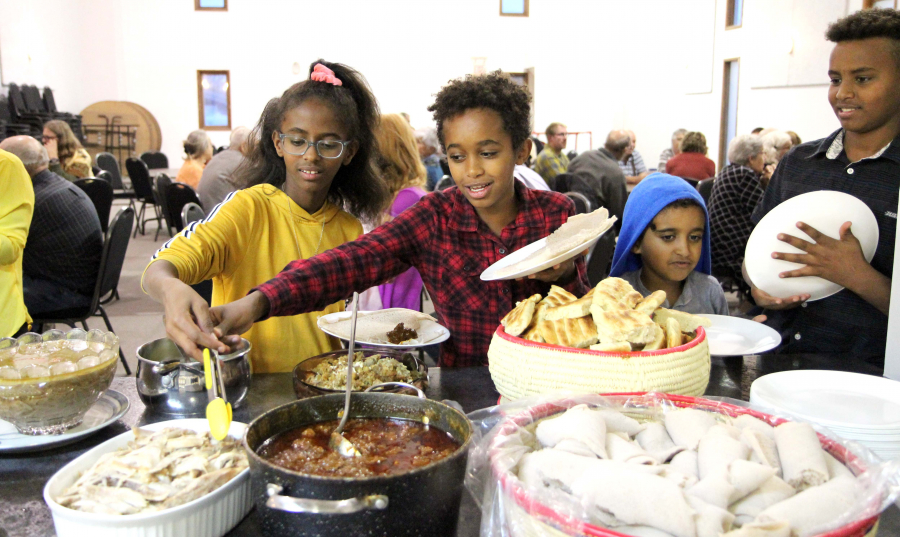
There was plenty of paperwork, and joining in with the experienced Mennonite Central Committee, they began working on bringing a family to the community. Despite the challenges, their first family arrived in July of 2016, actually quite quickly. Notwithstanding the starting point of the committee, the arrivals came from Eritrea not Syria. Goertzen said they did not designate a country to receive people from, instead welcoming whoever was needed. It brought interesting challenges.
“I was good at geography in school, but I had to ask ‘where is that country?’. We had to do some research, to find something out about that culture.”
The committee rented a house from Prairie Partners on Aikman Street, and the journey for the first family began. There were a lot of needs, but the community was able to fulfill them.
“All different people came together to make it work,” Goertzen stated. “You would ask people and they would show up. There would be a bed, furniture, a mini-van. People just came forward.”
The family integrated and grew, with Goertzen giving them credit for doing so well. It made it easier for them to welcome the next family a year later. From there, the committee has continued onward, working on reuniting these Eritrean families, bringing different members from different circumstances back together in their new home. There are presently five households in Boissevain.
Goertzen said everything has worked out better than anyone could imagine. The people are extremely grateful for their chance at a life in Canada. However, she finds they have to remind them that they too are a blessing to their new community.
“I tell them ‘we are glad you are here, you don’t owe us anything. Your presence is a gift to us.’ As newcomers become more a part of the community, we are in our lives together. We are aware of each other’s family situations. It’s fun to go to school, the pool, and hockey games. Our kids are doing life together.”
The committee is continuing its work. They have two more applications fulfilled, with more newcomers on the way at some point. As they have to take care of their needs for a year, it costs the committee around $20,000 per, and they are set for what they have taken on. A decision must be made for next year, however, and they are updating the different groups and churches involved in the effort presently. Goertzen said they are always asking themselves if the commitment in the community remains for them to continue welcoming new people. So far, Boissevain has shown the same spirit it did in the 1979-80 period when it came to people from Vietnam and Laos.
“There is a rich history of welcoming people in this community. There was the generation who modeled this for us. This community has stepped up so much.”
by PAUL RAYNER, Recorder staff