
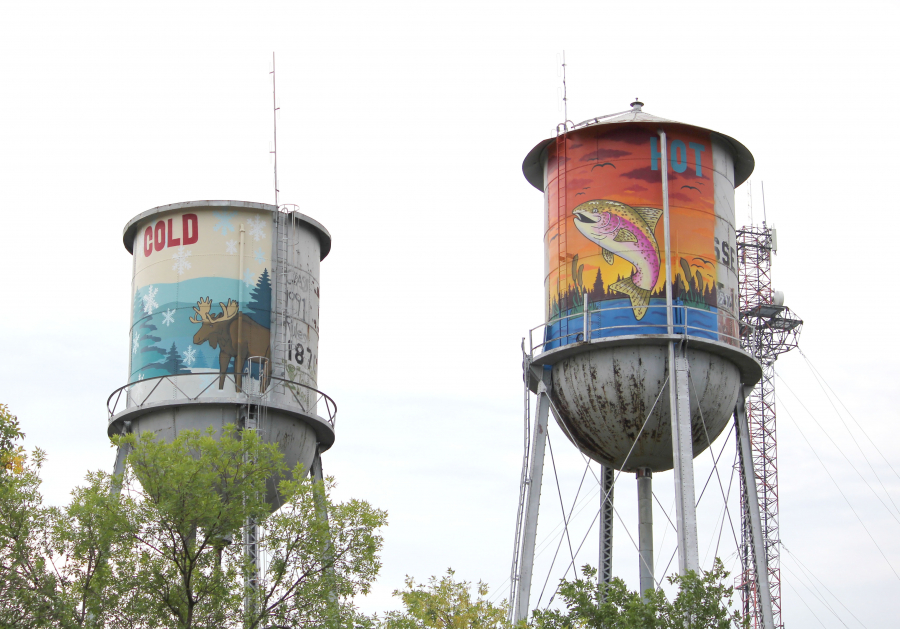
Initially, the thought was the artist could paint all around the towers. However, with the houses on the south side, this was not possible. Instead, the designs were put on the north side, the same as the Boissevain School bus garage. This does allow for some of the original look of the towers to remain, and with the murals on the north side,they will not age as badly from the sun.
Ness said the Arts Council told him they wanted to continue to work with the traditional “hot and cold” theme. In 1967, a couple of pranksters went up the ladder and painted “hot” on one tower and “cold” on the other. Everyone was so impressed by the idea, they decided to make it permanent. In 1970, the Boissevain Lions Club painted more permanent lettering to celebrate Manitoba’s centennial. This made the towers iconic, even though they have since been decommissioned.
To achieve everyone’s goals, Ness did scenes on each tower that gave a taste of two memorable Manitoba seasons. There is a moose to go with the cold, and a rainbow trout to go with the hot.
“I just kind of immediately thought of ‘landscape, winter, summer, season change.’ I wanted to keep the lettering consistent as well. I used the same font, with blue and red alternating letters, to tie everything together and just tried to paint some wildlife around the area.”
He admitted there were a few challenges. The lift was great, but there are differences in grade along the ground that had to be contended with by digging trenches. As well, Manitoba’s wind, which was not too bad much of the time, did flare up.
“It was a little bit hairy at times, but I was able to hide behind the tower as the wind was south, southeast. It wasn’t too bad, but I couldn’t get around to the left side of the tower that day (Sunday),” Ness stated.
Heide was thrilled with the end results.
“We’re really excited,” she said. “They have big, bright colours and you can see them from a distance.”
Heide added they were looking at possibly adding some lighting so they could be seen at night, making the towers more of a feature in the town. They will have to think about light pollution and the neighbours in the area, who were so cooperative during the painting process.
At the grand opening, Boissevain-Morton Deputy Mayor Rhonda Coupland explained the murals on the towers were part of the Boissevain-Morton Downtown Rejuvenation Project in cooperation with the Arts Council. They received funding from the Canada Community Revitalization Fund to help make the murals possible. She said they will help expand the outdoor art gallery, Boissevain’s main tourist attraction. They will ultimately help attract more people to the community.
Heide said when the Arts Council was first approached with the idea of a mural on the water towers, she did not think too much about the details but threw together a budget proposal. When they found out they were accepted in March, “the panic settled in”. However, the necessary miracles happened, and there is a new artwork in Boissevain.
She added they are hoping to have a video of the ribbon cutting playing at Street Fest on September 17.
This will not be the end for the Arts Council as it pertains to murals this year. There is also one planned for the west wall of the new Boissevain Dental Clinic on South Railway Street. As the building was once a telephone office, the idea is to have a mural celebrating the changes in communication over the years. The artistic duo Kerzeka of Calgary, made up of Tiziano Lombardo and Desiree Devloo have been chosen to paint the artwork.
Heide said the work would likely not be done until later in September, early October. The water tower mural was the time priority, and now they can focus on the second mural.
“This other one, we can take our time with,” Heide said. “It is easier to access the wall, and hopefully the weather will cooperate.”
Ness himself is happy to be a part of keeping history alive in Boissevain.
“I think it’s great,” Ness said. “I’m honoured to be able to contribute to this town’s history. Everybody seems to have a story with the tower, everybody who has stopped by, whether they have climbed it as teenagers, and there was a gentleman here who was one of the guys who painted it (in 1970). It’s cool to be a part of this town’s visual legacy.”
by PAUL RAYNER, Recorder staff