
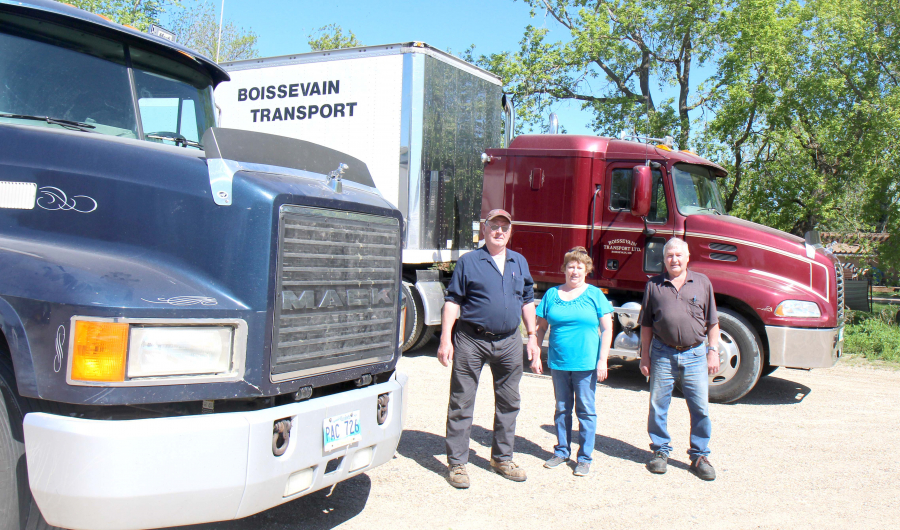
Ken added they retired at the right time, as the fuel prices are going crazy. He is not sure how some truckers are making it now, as sometimes it takes companies they work with a month or so to give a little boost to make up for fuel hikes. With John’s truck you can put about 1,100 litres of fuel in, so one can see how expensive the business is right now.
There are also new electronic log books coming in, which are changes the two Arthur drivers were not prepared for at this time of their careers. The decision was made to shut down, and the driving stopped in February.
Boissevain Transport started in 1961 when John and Ken’s father Gordon and their uncle Thomas purchased Hammond Transport from Art Hammond. Gordon ran the business out of Boissevain and area, while Tom did the same for Deloraine and area. They hauled freight from Winnipeg and Brandon to their local areas and livestock to plants and to auction marts in places like Brandon, Melita and Killarney.
John and Ken became involved in the business at young ages. They remember helping load trucks, as well as travelling with their father on some trips. This included helping load up livestock for shipment, as well as other difficult merchandise.
“There were no forklifts back then,” John said. “It was all done by hand.”
Once they reached legal age, they acquired their Class 3 licenses, which allowed them to do pick ups and deliveries in Brandon. After graduating high school, they could get the Class 1, which allowed them to start driving semi trailers. Picking up these important licenses was not as difficult as today, as Ken explained.
“You would go down to the town office and lay down three bucks, and you could get a chauffeurs license, which is a class one today,” he explained. “It cost three bucks.”
“There was no test or anything,” John added, “but you were learning hands on from your parents. There were drivers here, and you learned from them, rode with them. To help them load and unload. It was hands on learning, just like the farmers. The kids on the farm didn’t just hop in the tractor and know everything. They learned.”
Ken said when he started to drive to Winnipeg, they had a guy in there to help him find his way, and he was able to learn from him as well.
They hauled out of Brandon and Winnipeg. One of the changes that came over time was Brandon ceased to be a centre for wholesalers like Western Groceries, or packing plants like Burns. Even in Winnipeg, plants began closing, as the business moved south.
One of the important parts of the business was never to travel empty if possible. This means hauling in and hauling out. As an example, if Boissevain Transport hauled cattle into Winnipeg, they would wash out the trailer and load freight the next day in the city, bringing it out to Boissevain. This was crucial to make the business work. This has become more difficult as time went on.
Over time, they purchased grain trailers, Gordon and John started hauling grain for local farmers to elevators. A bale trailer was also acquired to haul hay/straw bales. In the late 1980’s Gordon and John started hauling livestock to the US, to packing plants and auction marts for the bigger feedlots. They also hauled hogs to Brandon, Neepawa and later across the border. There were trips to Minnesota, South Dakota and out to Alberta.
In recent years, they became involved in hauling recycling from Boissevain to Portage and Brandon.
In fact, over the years, they have hauled nearly everything. Augers, swathers, hardware, tractors and equipment, groceries, farm chemicals.
“Anything that would fit in a trailer,” Ken stated.
By 1972, both brothers were driving. John’s wife Chris became involved in the business in 1986. She worked in the office, and travelled with John sometimes.
Over the many years they were involved, the industry definitely changed. At one point, trucking companies had areas they could haul freight in, and paid for them. They could not haul in other areas. If a larger company brought freight from another province for Boissevain into Winnipeg, they had to call the local company to come pick it up. The government eventually de-regulated the industry, which brought in larger competition and made it difficult for smaller truckers, as they can cut rates. What they did not do was cut the insurance and licenses for trucks. It became go big or go home.
There is a lot more regulation and insurance is much more costly. Not to mention fuel. John said he remembered way back when a gallon of gas was 25 cents. It is a little different today. Diesel used to be cheaper than gas, but that too has changed. Ken figures in part it might be because those using diesel have to have it, so they are a bit of an easy target. This will have an obvious impact on everything, as everything needs to be shipped.
“This country isn’t getting any smaller,” John said. “It will cost more to ship from point A to point B.”
Trucks are larger than when they started as well, as are trailers. There are more warehouses that run 24 hours, which means more night driving. Companies are running their own trucks and their own drivers. However, there is getting to be a shortage of drivers, as younger people are not interested in the lifestyle.
Over the years, there were many people employed with the company for driving, unloading freight and office staff. Many drivers were in and out, and John and Ken both figure they have each drove over a million miles, with many trucks used.
It was a good business, and the family said they are very proud of the service they gave to Boissevain and area. They want to thank all of their customers for the business and support over the past years. When exactly Boissevain Transport will officially be done is up in the air as there is a lot of equipment and property to sell. They have some plans for retirement, but the key is they will not be tied down.
There are aspects of the business they will not miss, like driving nights when it is -50 with a windchill. However, it was a way of life for a lot of years.
“Yeah, I will miss it.” John said. “There was always work to be done, from when we were young. It’s just time.”
“We never had to go looking for work,” Ken said. “There was work here.”
by PAUL RAYNER, Recorder staff