
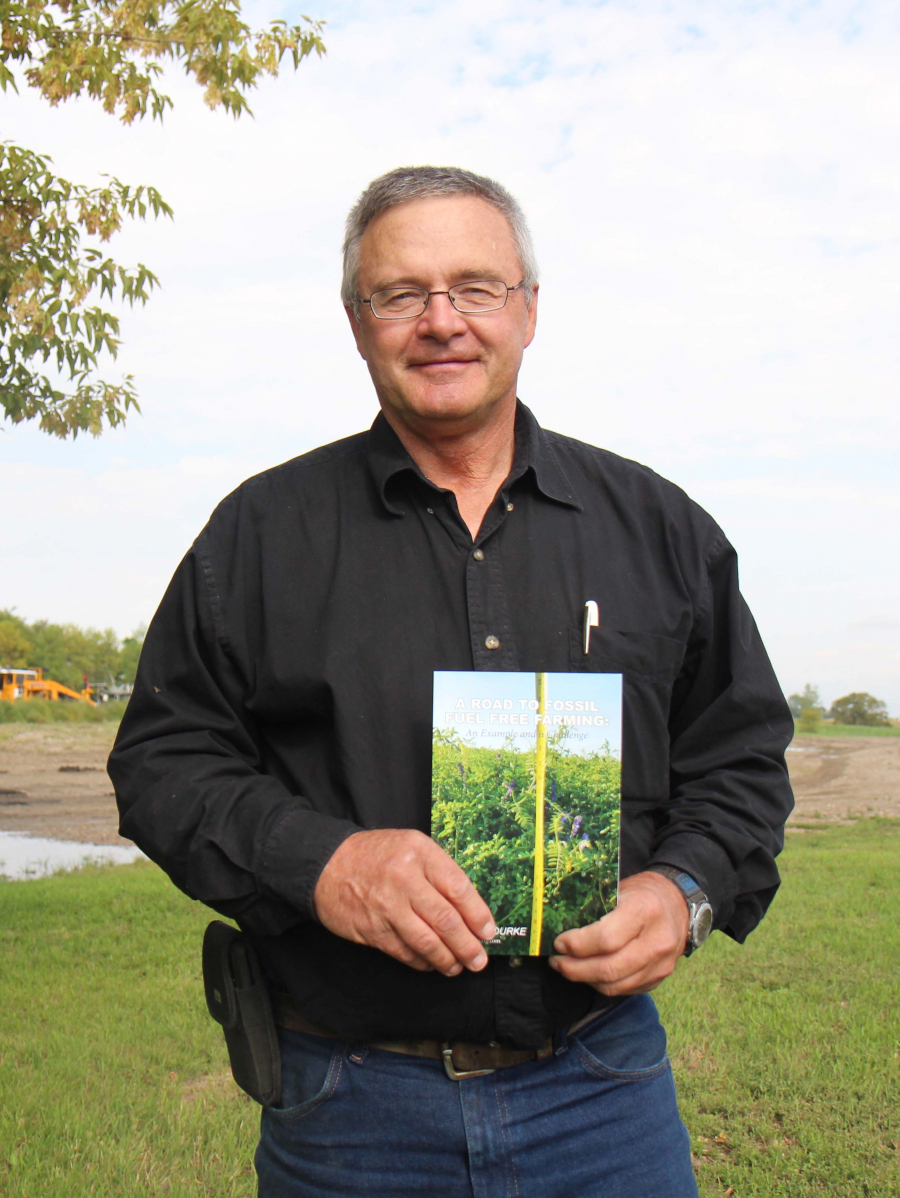
“That really started the journey,” Rourke said. “That would be in about 2015, just when the Paris Accord was starting. It looked as if that might be a tipping point of people finally recognizing global warming was something they had to pay attention to.”
During those years, Rourke said he kept looking for better ways to farm. He and his son experimented with organic farming on the entire operation. A long time advocate of zero till farming, Rourke felt it needed to be expanded. As an example, he said if a producer stops using nitrogen fertilizers they could reduce their carbon footprint by around 50%.
A second happening was he was asked to do a poster, which he titled “The Path to Fossil Free Farming”. After he did it, he crossed out the “the” and replaced it with an “a”, and added “an example and a challenge”. While COVID raged, Rourke took some time he began writing the book over a month or so.
“It is some accumulated knowledge with a little wisdom over 40 years.”
Climate change is an issue that has become inescapable over the last few decades. It has happened in various ways for millions of years, but focus now is on anthropomorphic, or human-caused, changes. Rourke said over history, humans have been able to degrade their environment. This has led to lost civilizations and people moving on. We keep doing this on and on. James Hansen in the 1970’s confirmed that carbon pollution was having an impact on temperatures.
“We’re not destroying our local ecosystem,” Rourke explained. “We’re destroying everything we are depending on. That seems irresponsible to know and not do something about.”
He said there are different people with different reactions. Some deny climate change, some deny people are responsible, some think we are doing all we can, and others feel we are already doomed. Rourke feels we can fix it.
“This is me not knowing any better again, but with some experience, some knowledge, a basis in science, I can help expand the thinking of various groups and people.”
His book opens with his personal journey to discovering climate change. He introduces himself and his work over 40 years. Also included is scientific evidence of the temperature changes that threaten the planet.
The book moves on to different possibilities for agriculture to reach carbon free farming. This is a difficult challenge, for sure, but Rourke feels it is achievable.
Getting people on board can be one of those challenges. Agriculture can be a hard way to make a living, as Rourke well knows. Right now, farmers are paid for their yield, not for the environment. There might be some changes needed.
At any rate, there are several different models he proposes to help with the situation.
“I shouldn’t say there are an infinite number of models, but there are likely an infinite number of variations.”
Much of it comes down to the larger farms on the prairies, finding alternative power sources to fossil fuels and finding ways for them to better sequester carbon.
In his examples, there are different ways to power a farm. He readily admits fossil fuels do the job very well, but in a way that hurts the environment. Electric power might end up being a little fanciful for operating equipment. Rourke feels the easiest way might be straight vegetable oil. Equipment already exists that runs on it, although starting it needs some diesel or biofuel to warm the oil. He said this is on the fringe right now, but there could be some laws in the future that demand a lower diesel usage. Rourke added it could even be a part of the farm if you can crush your own meal. In his case, he would likely use soybeans.
Using biological nitrogen, through cover crops, could help replace fossil fuel nitrogen as a fertilizer, also helping the situation. Rourke said some think they can get to a 100% replacement through that method, although that is not yet proven.
As for larger power sources, Rourke is open to many different types. Although many more orthodox environmental thinkers have centred exclusively on wind and solar, he feels we need all kinds of non-carbon forms. There have been interesting developments in wind power, including prop-less towers, and there is room for solar power, if not taking prime land. Nuclear power is moving into producing fewer waste products, or using them for energy. Hydrogen from the ground can also help.
“There are always new innovations,” he explained. “As I said in the book, man’s technology got us into this trouble and now it can get us out of it. The power in a gallon of gas is enormous. It will take a lot of work to (replace) that.”
Unlike others, Rourke is also pro-livestock. He said cattle are essentially a ruminant animal. Cattle and bison helped build the soil in the first place and can do it again. They are part of nature; good at building soils and can play a role.
Cutting down or eliminating carbon is the first step. Producers must also improve their carbon sequestering capabilities, of putting carbon back in the soil. He feels the best ways of doing this are the regenerative principles. This would include growing “snow to snow”, or as long as you can. There also needs to be diversity in what is grown on the land. The third idea would be having as much cover as possible on the fields. Also, you need to disturb the soil as little as possible, to keep the microbes in. This includes limiting tillage and use of pesticides.
There are a number of reasons to do this work. Rourke said climate change has many impacts, some we do not realize. It could increase heavy migration as people move away from negatively impacted areas. Do we not want to keep people where they are and where they are comfortable? In the book, he also stresses people have to look at the larger world, and look to changes from our leadership in a bigger way than just in farming.
Rourke, who is currently working on his PhD, which is focusing on what is missing in prairie agriculture to move it in line with climate change findings, said sometimes it would be easier for him to “just go to the lake.” However, when he thinks of the world his grandchildren will inherit, it seems irresponsible to go there and vegetate. On their farm, changes are progressing, as covered in the book. He uses an electric bike to get around the different parts of the land. It is a challenge for them as for everyone, but he feels they are moving in the right direction.
Anyone interested in the book can order from the website fossilfuelfreefarming.com. It costs $20 plus shipping and handling and there is an e-book and audiobook.
In the book, Rourke compares the issue to putting a man on the moon. That too was seen as impossible, but it needed a commitment. This too needs that commitment. It is, he said, more than possible.
“I want to create awareness and a little bit of hope. We’re all in this together and it’s not impossible.”
by PAUL RAYNER, Recorder staff