
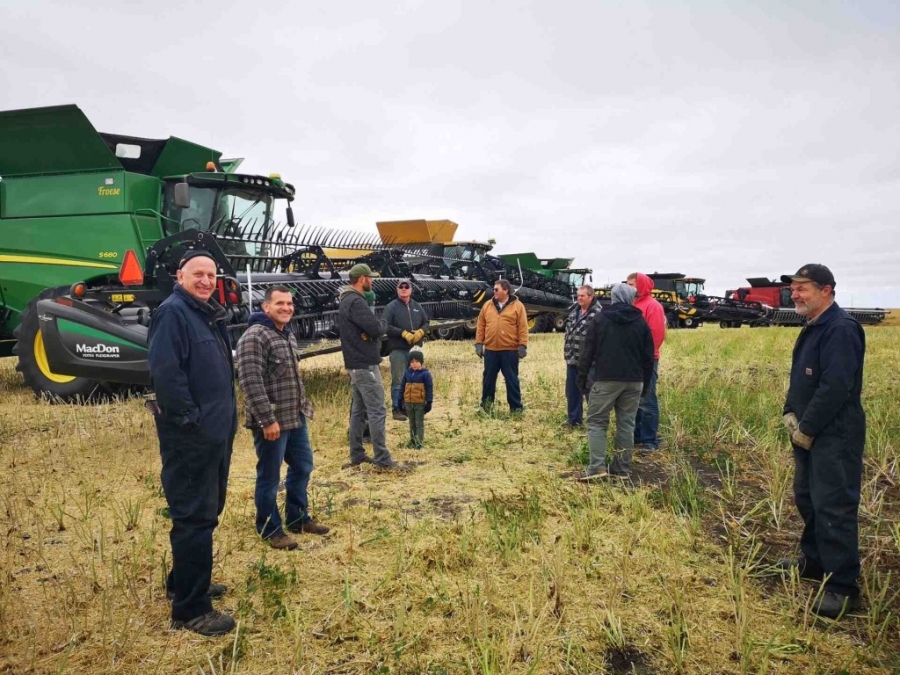
“We always enjoy having a lot of people there for lunch, but we got more people there with equipment this year, so we were able to wrap up more quickly.”
This was quite different from 2019. Last fall, rain and snow combined to make harvest a challenge for all producers. It also meant the growing project, which raises crops for the Canadian Foodgrains Bank, could not get their harvest done at all. Peters said they took a look at the wheat they planted in 2019 this past spring and could not salvage it.
“It was not worth anything in the spring time,” Peters said. “We couldn’t get it off, so we torched it. It was not our first choice, but we had to do it.”
This made the field available for a new crop. Initially, they were looking at peas, but spring was a little late from the leftover wet conditions. They eventually settled on canola, which worked out pretty well.
“Being seeded late did not hurt it. The canola was excellent. Thankfully, we had heat all summer, because it was seeded late. If we had had cold weather for three weeks, it would have been late coming off.”
As it was, on harvest day those on the combines said it was a little “chewy” to start, as there had been frost the night before. However, on the 290 acres, they were able to get 50.8 bushels per acre, with only a drop or two from scattered showers. They sent this off to Viterra in Boissevain.
Peters said they were able to get $11 a bushel for the crop. He is not sure how much of that will go to the Foodgrains Bank, as they had expenses, but it should still be considerable.
Crop insurance took care of the losses from 2019, and they still were able to make a donation to their cause. Peters added they did okay with donations to their project last year, but he figures they will be down a little on that in 2020. Due to the coronavirus, they were not able to do a lot of their activities they do as fundraisers. In 2019, they had great success with their combine pull on Canada Day, and were looking forward to reprising it at the event this year. However, it was cancelled. People also make donations at the harvest meal.
“Without being able to do our activities, I think the donations will be lower,” he stated. “We hope to get our events up and going again next year.”
The Canadian Foodgrains Bank is a partnership of 15 churches that work towards ending world hunger. They take donations, purchase food and send it to people in need. As well as emergency assistance, they have longer-term projects to help people produce food for themselves. One way people help the bank is by banding together and growing crops, selling them and donating the proceeds. Donations are matched 4:1 by the Canadian government. There are currently over 200 growing projects across Canada and they supply about half the needs of the Foodgrains Bank.
Peters said the local group does not specify any area for their donation to target, instead allowing CFGB to make that decision, as they have the expertise to know where it is most needed.
“We provide them with a donation, they distribute it where they can.”
They have been growing their crops on land owned by Del and Heather Fraser for many years and plan to continue doing so there. Peters said they have not decided what crop they will plant in 2021, as that might be a discussion point for next month. Overall, the project has been running for more than two decades, and the enthusiasm is there to keep it going.
“It is something we feel passionate about,” he explained. “It is a way we can use our skills to help people. We are passionate about keeping it going like we have before. It has been around 23 years now and we are looking to carry it forward.”
by PAUL RAYNER, Recorder staff