
“This has been a discussion for many years,” Swanson said prior to the meeting. “We have done our research, done our studies, done our testing. The decision this council made was to go ahead with an aerated lagoon with a synthetic or clay liner.”
Council has had many meetings over three years with different companies over lagoons, with the aerated being one of the most simple. They needed to hold a public meeting to start the process of setting the funding formula, so the province can approve it. Once the approval happens, the municipality will be preparing for grants for the project moving forward.
“The basic idea is to be ready. We have applied for a provincial/federal grant. We need the help from both the federal and provincial level, because a community this size cannot handle something like this on our own. We need to be prepared for that.”
The amount for the lagoon being proposed is $9,958,000. It is a pricey project for sure, although Swanson said that is on the highest end. They have to plan for the worst-case scenario, both in overall price and with borrowing interest rates. As well, it is based on the information provided by the engineer StanTech. There are many ways it could come in under that amount, particularly through the use of local contractors and services. As well, they are no longer tied to StanTech, and could find a less expensive alternative in the future.
The amount Boissevain-Morton applied for under the Clean Water + Wastewater fund was for $7.3 million from the province and the federal government. If this were to be collected, the municipal portion would be $2,655,798.60.
They would collect this money from two tax sources. The first would be a per parcel rate from each property connected to the utility in Boissevain-Morton and vacant lots. This would total $1,327,899.30. The same amount would come from a special mill rate on all of that property.
Interestingly, for the per parcel rate, it is possible to pay it in one lump sum of $1,754.16, or to finance it over time. For some, if they have the money, it would be beneficial to pay it in one shot. There is no time frame for it as of now, because they are not sure how much it will really be, as these are high end numbers.
The special levy would cost a house worth $100,000 in 2020 about $68 extra on their taxes. Higher assessed homes would see the tax amount increase accordingly.
The site has not been laid down, but Swanson said they have been looking at the present landfill site – this is what the costing was based on. It is a distance to pump the waste, and they will be looking at different sites as well, which if closer could keep costs down too.
Swanson said they did struggle with the idea of keeping the meeting on its original date. With the coronavirus situation, there were questions about safety and propriety. Modern communications made it possible, and limiting numbers, sending RSVP’s and questions ahead helped. If they changed the date, the municipality would have to go through many hoops that would take a lot of time. There is a need to get the project moving, at least in its initial stages.
As for the grants, the municipality knows the province has done its review and has passed it on to the Canadian government. When they find out is hard to say.
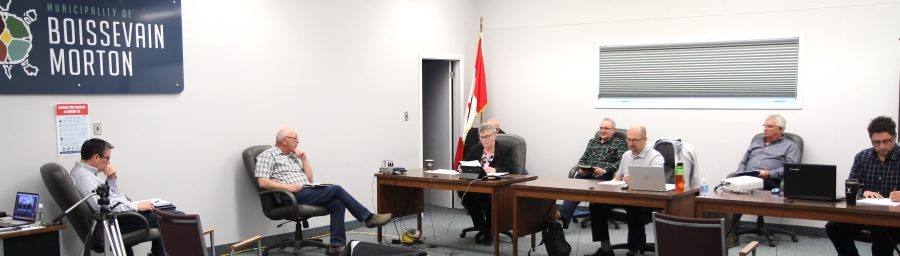
At the meeting, the municipality’s consultant Ernie Epp explained the project to the small group in attendance, and those watching and listening. As he stated, Boissevain-Morton’s lagoon is likely the oldest in Manitoba and has been an issue since 1988. This is the best chance to move the operation, and the money available from federal/provincial sources is a historically high 73.3% of the project. The borrowing will take place over 20 years, and the letters on the per parcel amounts will not likely come out until 2022 or 2023. If all goes well, the new lagoon would be built in 2021, with decommissioning in the next year.
Council passed first reading on the funding by-law after the hearing.
by PAUL RAYNER, Recorder staff